
Understanding Porosity and Its Role in Reservoir Evaluation
Porosity is a key thing to know about rocks in petroleum engineering and in looking at rocks. It shows you the percent of open space inside a rock. This tells people how much oil, gas, or water the rock can hold. Good porosity checks are important because they tell us how good the rock is, help figure out how much oil or gas there can be, and show how fluids move under the surface.
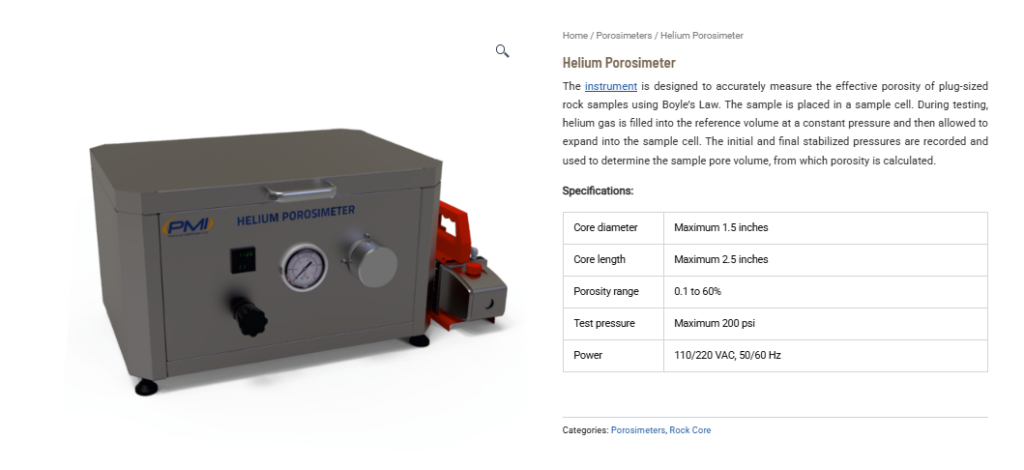
The Helium Porosimeter is a tool used in the lab. It helps you find how much open space is in small rock core samples. The tool uses Boyle’s Law and helium gas to do this. You get results you can trust each time. It does not harm the samples. You can use it when you do research, teach classes, or need to study or test rock cores.
What Is a Helium Porosimeter?
A Helium Porosimeter is a tool you use in a lab. It helps you find out how much space is in the pores of a rock. It also tells you how much gas or liquid can move through the rock. The device does this by putting helium gas into a closed space. Then, the gas is released into a space that has the rock sample.
The tool looks at the pressure before and after the gas goes out. It then uses this to find out the size of the pores in the sample. With this info, you can know what the true porosity of the rock is.
Helium molecules are very small. They do not react with other things. Because of this, they can pass through tiny pores. This is why helium porosimetry is a good way to find out the porosity of a sample.
How Helium Porosimetry Works
The Helium Porosimeter uses Boyle’s Law. This law explains how pressure and volume change in a closed gas system.
The testing process includes:
- Put a rock core sample in the sample chamber.
- Let helium gas fill the reference volume. Make sure to do this at a set pressure.
- Let the helium move into the sample chamber.
- Write down the steady pressures at the start and end.
- Find the pore volume by checking the change in pressure.
- Work out the real porosity by using the sample size and the pore volume.
This way of doing things gives good porosity measurements. It also keeps the sample safe.
Key Features of the Helium Porosimeter
1. Accurate Effective Porosity Measurement
The system is built to see how much of the plug-sized rock core is empty space. It checks this each time, so you get the same result. This means you can trust it.
2. Boyle’s Law-Based Measurement
When you use the well-known rules from Boyle’s Law, you get pore volume numbers that you can trust. This makes it easier to find out the pore size. You also stay in line with what most people in the industry do.
3. Wide Porosity Measurement Range
The instrument measures porosity values from:
0.1% to 60%
This way works well for many types of rocks in the earth and for different rock layers that have oil or gas.
4. Helium Gas Technology
Helium is very small. This helps it get into the tiny spaces in a thing. It can go into spaces better than other ways people use. Because of this, the numbers for pore volume are more right when you use helium.
5. Non-Destructive Testing
Samples stay whole while the testing is done. This lets people use them for more tests in the lab after the first ones. People can look at things like permeability, saturation, or do some mechanical tests with them.
6. User-Friendly Operation
The system is built to be simple to use in a lab. It works well in research places. You can use it in schools, too. Business labs that do core analysis also get good use from this system.
Technical Specifications
| Specification | Details |
|---|---|
| Core Diameter | Maximum 1.5 inches |
| Core Length | Maximum 2.5 inches |
| Porosity Range | 0.1% to 60% |
| Maximum Test Pressure | 200 psi |
| Power Supply | 110/220 VAC, 50/60 Hz |
Why Helium Is Used for Porosity Measurement
Helium is the main gas people use to see how much empty space there is in an object. This is because the gas has some special things about it that are very important:
Small Molecular Size
Helium can move into very small spaces. Other bigger gas molecules may not be able to get in like it can.
Chemically Inert
The gas does not react with the rock minerals at all. It does not change what the sample is like during the test.
High Measurement Accuracy
Helium expansion methods work well for pore volume tests. With this way, you get numbers you can trust.
Industry Acceptance
Helium porosimetry is used around the world as a good way to measure porosity in a lab.
Applications of the Helium Porosimeter
Petroleum and Natural Gas Exploration
Check how much empty space is inside the rock. This tells you how much hydrocarbon the rock can hold. It also helps you see how good the rock is for holding that hydrocarbon.
Core Analysis Laboratories
Get real porosity data that people can use to find facts about reservoirs. It is also helpful for lab work on rocks.
Geological Research
Look at the pore structures in both sedimentary rocks and rocks that are not usual. This will help you know how these rocks keep things inside. By doing this, you can find out what is inside and how much it can hold. It will show you their pore spaces and help you see how gas or water gets stored. It is also good to know how people use these rocks in work that needs these uses.
Academic and Educational Institutions
Give students a chance to practice how to measure porosity and do core analysis with their own hands. Let them work on these tasks so they can learn by doing and get real experience.
Carbon Capture and Storage (CCS) Research
Look at how much space the rocks in the ground have. See if these places can keep carbon for a long time in carbon sequestration projects.
Benefits of Using a Helium Porosimeter
Reliable Data
Get porosity numbers that are always correct and do not change. You will get the same result every time.
Fast Testing
Get quick results and keep your core samples safe.
Improved Reservoir Characterization
Get key porosity data for the study and development planning of the area.
Cost-Effective Operation
Simple testing steps help save time in the lab. They also make things get done faster.
Versatile Applications
This is good to use for most oil fields. It also works well in hard rock places. You can use it for studies on shale. People also use it for research in earth science.
Why Choose the Helium Porosimeter?
The Helium Porosimeter uses Boyle’s Law to test rock core samples. It works with helium gas. This tool gives good and steady results every time. The way the tool works does not hurt the samples. It can find out pore volume easily. A lot of people in oil, research, and lab work like to use it for this reason. It is good for many jobs and can help in the lab.
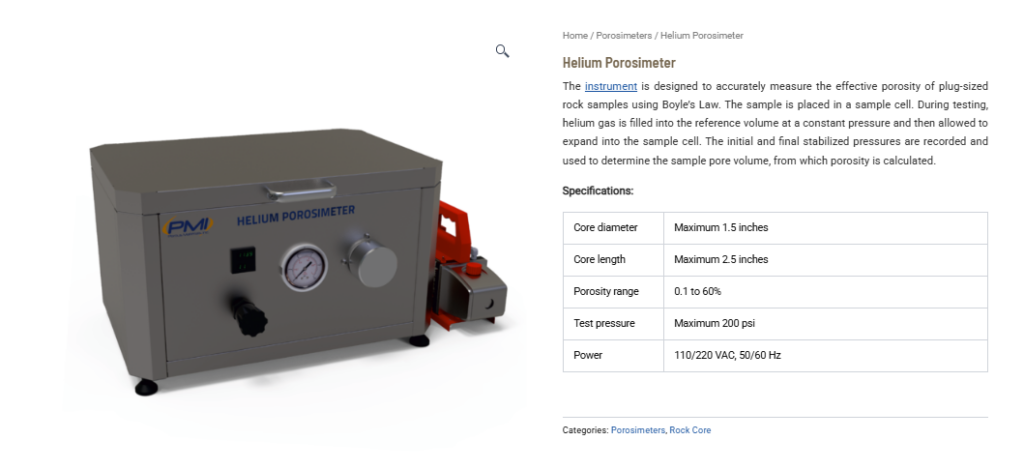
The Helium Porosimeter helps people learn about rock layers. It is great for use in research at schools and in study programs. The machine gives good results for porosity tests. It does measurements well each time for the user.
VLOG BY : PMIAPP