
Table of Contents
Introduction
Keeping the right pressure level is important in many kinds of science, work, and research jobs. You may need to check what things are made of, test how well filters work, see how membranes hold up, watch how fluids move, or check quality. When you keep good pressure all the time, your results get better. This helps make sure tests give the same results each time.
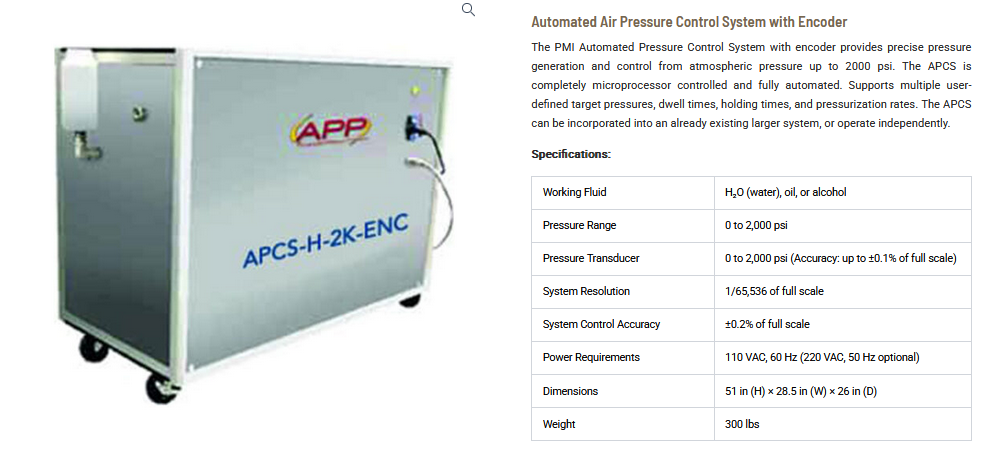
The Automated Air Pressure Control System with Encoder (APCS-H-2K-ENC) from PMI uses a microprocessor to make and keep air pressure steady. It is built to be stable, simple to use, and needs little help to run. The APCS can give air pressure up to 2,000 psi. This is good for people like researchers and engineers who need to work with air pressure. It is a reliable choice for those who want to handle air pressure, whether the system works alone or with other devices.
What is an Automated Air Pressure Control System?
An Automated Air Pressure Tool (APCS) is a smart way to set air pressure. It helps to make, check, and keep the air pressure right. The APCS can work by itself. You pick the pressure you want. The tool keeps watch on the air and makes changes on its own. You do not have to do the job by hand.
The PMI APCS-H-2K-ENC has new encoder parts and smart controls. This lets it set pressure in a way that is right every time. It can give any amount of pressure, from normal air up to 2,000 psi.
The system allows users to define and automate:
- Target pressure values
- Pressure ramp rates
- Hold times
- Dwell periods
- Pressure cycling sequences
- Automated test profiles
This type of automation makes testing quicker and easier. It helps people do less work in the process.
Why Precise Pressure Control Matters
Pressure is one of the most important things in both lab and factory tests. Even small changes in pressure can change:
- How well the stuff works
- Testing the membrane to see if it is in good shape
- Looking at how well something filters
- Finding out more about the porous stuff
- Checking how things flow
- Testing how strong something is when stress is put on it
Advanced pressure systems help get rid of differences and make experimental results better and more reliable.
Key Features of the APCS-H-2K-ENC
Fully Automated Operation
The APCS is fully controlled by a microprocessor. You can use it to run detailed pressure profiles on its own, and you do not need to watch the system all the time.
Benefits include:
- Less work for the person running the machine
- More tests that give the same result each time
- The same set-up for testing every time
- People can get more done
Wide Pressure Range
The system delivers pressure control from:
0 to 2,000 psi
This wide working range makes it easy for the APCS to be used in many labs and factories. It can work well for low-pressure, medium-pressure, and high-pressure testing.
High-Resolution Encoder Technology
The built-in encoder helps you get better pressure tracking. It also lets you have more say over what happens. You can do each part better with it.
System Resolution
1/65,536 of full scale
This high resolution lets you make very small changes to the pressure. You can also have good control of the pressure at every step in the testing.
Exceptional Accuracy
It is important to keep the right pressure. This helps you get good data that you can trust.
Pressure Transducer Accuracy
Up to ±0.1% of full scale
System Control Accuracy
±0.2% of full scale
These rules help people trust each test and each measurement.
Programmable Pressure Profiles
People can create their own test steps by programming.
- Pressure goes up
- Pressure goes down
- Speed of change
- Wait times
- Steps in pressure cycles
This skill is good for automatic research. It also helps when you want to check if products are up to the right standards.
Flexible Integration Options
The APCS can operate:
As a Standalone Unit
This is good for small testing sites and labs.
Integrated into Larger Systems
The APCS can be incorporated into:
- Membrane testing systems
- Porometry instruments
- Filtration testing equipment
- Pressure vessel testing setups
- Research automation platforms
Compatible Working Fluids
The system can use more than one fluid for work. The, you get flexibility to use it for different jobs.
Compatible fluids include:
- Water (H₂O)
- Oil
- Alcohol
This makes the system good for many things. People who do research can change it to work for what they want in tests.
Technical Specifications
| Specification | Details |
|---|---|
| Working Fluid | Water (H₂O), Oil, Alcohol |
| Pressure Range | 0 to 2,000 psi |
| Pressure Transducer Accuracy | Up to ±0.1% of Full Scale |
| System Resolution | 1/65,536 of Full Scale |
| System Control Accuracy | ±0.2% of Full Scale |
| Power Requirements | 110 VAC, 60 Hz (220 VAC, 50 Hz Optional) |
| Dimensions | 51 in (H) × 28.5 in (W) × 26 in (D) |
| Weight | 300 lbs |
Applications of Automated Pressure Control Systems
Membrane Testing
Pressure plays a big role when you talk about membrane characterization. It also matters a lot in how well the filtration works.
The APCS supports:
- Test how strong the membrane is
- Check the bubble point
- Study how well the filter works
- Measure passage
Porous Material Characterization
Researchers use set pressure to see:
- Pore size spread
- Open spaces size
- Flow blockage
- Let’s flow through
Filtration Research
Being able to manage the pressure well lets you look closely at:
- How well the filter works
- How it lets things pass through
- How much it keeps in
- How the pressure changes when things move through
Material Science
Testing that keeps the pressure in check is needed to see:
- Structural strength
- How well it works with force
- How long what it’s made of will last
- How it reacts to pressure
Industrial Quality Control
Manufacturers use automated pressure systems to meet these needs:
- Product testing
- Leak testing
- Process checking
- Quality checks
Advantages of Automated Pressure Control
Improved Repeatability
Automation takes away changes that come from people running it. This helps us get the same results every time.
Enhanced Testing Efficiency
If you use programmable pressure profiles, you can cut down on setup time. These can make each testing step much easier and faster.
Greater Data Accuracy
Careful tracking in high resolution helps you get the right results, and makes sure you feel good about them.
Reduced Human Error
Automatic pressure regulation can help cut down on mistakes that people might make when they change settings by hand.
Increased Laboratory Productivity
Researchers can create longer test series. They can add more steps. You do not have to watch it much.
Why Choose PMI’s APCS-H-2K-ENC?
PMI is trusted worldwide for making top tools. People use their products in membrane science. Their tools are important in testing porous substances. They help in filter research and tests that use pressure controls.
The APCS-H-2K-ENC offers:
- The system can make the pressure go up or down in small steps.
- The tool uses a good encoder to help with how things are run.
- It gives very good results.
- It works on its own.
- You can set it up with many other things.
- It is built for tough work in factories.
- It works well for a long time.
These features make it a good choice for labs, research teams, makers, and places where they test quality.
Conclusion
The Automated Air Pressure Control System with Encoder (APCS-H-2K-ENC) is a strong and reliable tool. It helps you test pressure in the best way with several steps. This system can make and handle air pressure that goes up to 2,000 psi. It does this job in a very steady and sure way. That is why it is good for science tests, building new things, and checking if a product works well in a factory.
You can use the APCS by itself to make pressure. You can also use it with a bigger testing setup. The APCS gives you what you need for hard work in labs and factories today. It is good for both performance and flexibility.
POST BY : PMIAPP