
Table of Contents
Introduction
Understanding the flow behavior of fluids through porous rock formations is critical in petroleum engineering, reservoir characterization, carbon sequestration, groundwater studies, and geological research. Accurate measurement of permeability, capillary pressure, and electrical resistivity helps researchers and engineers evaluate reservoir performance, optimize production strategies, and improve recovery efficiency.
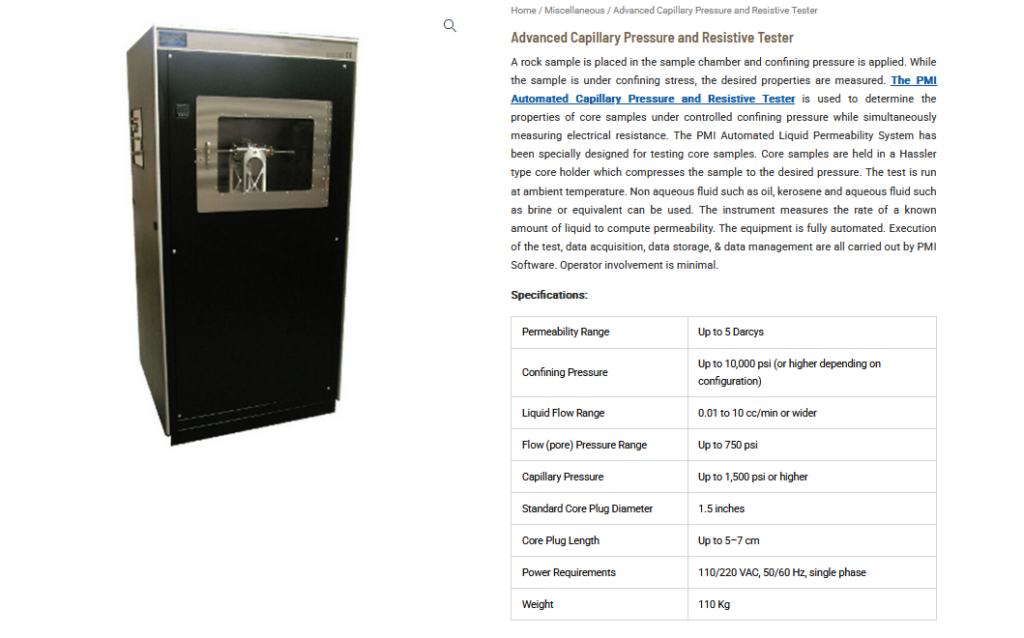
The Advanced Capillary Pressure and Resistive Tester from PMI is a sophisticated automated testing system designed to measure the physical properties of rock core samples under controlled confining pressure conditions. By combining permeability testing, capillary pressure analysis, and resistivity measurements into a single integrated platform, this system provides comprehensive core characterization with minimal operator intervention.
What is an Advanced Capillary Pressure and Resistive Tester?
The Advanced Capillary Pressure and Resistive Tester is a laboratory instrument specifically designed to evaluate the transport and electrical properties of porous rock samples. During testing, a rock core sample is placed inside a specialized sample chamber where controlled confining pressure is applied to simulate subsurface reservoir conditions.
While the sample remains under pressure, the system simultaneously measures:
- Permeability
- Capillary pressure
- Electrical resistance
- Fluid flow characteristics
- Rock-fluid interactions
The result is a highly accurate representation of how fluids behave within porous geological formations.
Importance of Core Sample Testing
Core analysis plays a vital role in numerous industries where understanding subsurface rock behavior is essential.
Petroleum and Natural Gas Exploration
Engineers use core sample data to:
- Determine reservoir quality
- Estimate hydrocarbon recovery potential
- Analyze fluid saturation behavior
- Optimize enhanced oil recovery (EOR) methods
Carbon Capture and Storage (CCS)
Accurate permeability and capillary pressure measurements help assess:
- CO₂ storage capacity
- Seal integrity
- Long-term storage security
- Migration pathways
Groundwater and Environmental Research
Researchers use permeability and resistivity data to study:
- Aquifer characteristics
- Contaminant transport
- Soil and rock permeability
- Water resource management
Geotechnical Engineering
Core testing assists in:
- Foundation analysis
- Tunnel construction planning
- Slope stability studies
- Geological risk assessment
How the System Works
The PMI Advanced Capillary Pressure and Resistive Tester utilizes a highly controlled testing process.
Step 1: Core Sample Placement
The rock sample is installed inside a Hassler-type core holder specifically designed to apply uniform confining pressure around the sample.
Step 2: Confining Pressure Application
Pressure is applied to simulate real reservoir conditions. The system can generate extremely high confining pressures to replicate deep subsurface environments.
Step 3: Fluid Injection
A selected testing fluid is introduced through the core sample. Various fluids may be used, including:
- Brine
- Water
- Oil
- Kerosene
- Equivalent non-aqueous liquids
Step 4: Flow Measurement
The instrument measures the flow rate of fluid passing through the sample to determine permeability characteristics.
Step 5: Electrical Resistance Monitoring
Simultaneously, electrical resistance measurements are recorded to evaluate pore structure, saturation levels, and fluid distribution within the rock.
Step 6: Automated Data Collection
All test parameters are continuously monitored, recorded, analyzed, and stored through PMI’s integrated software platform.
Key Features
Fully Automated Operation
The system automates:
- Test execution
- Data acquisition
- Data storage
- Data analysis
- Report generation
This significantly reduces operator involvement and improves testing consistency.
High-Pressure Capability
The instrument is capable of generating extremely high confining pressures, enabling accurate simulation of reservoir environments.
Simultaneous Multi-Parameter Measurement
Researchers can obtain:
- Permeability data
- Capillary pressure data
- Resistivity measurements
from a single test setup.
Advanced Software Integration
PMI software manages the complete testing workflow while providing real-time monitoring and analysis capabilities.
Flexible Fluid Compatibility
The system supports a wide range of testing fluids for diverse research applications.
Technical Specifications
| Specification | Details |
|---|---|
| Permeability Range | Up to 5 Darcys |
| Confining Pressure | Up to 10,000 psi (or higher depending on configuration) |
| Liquid Flow Range | 0.01 to 10 cc/min or wider |
| Flow (Pore) Pressure Range | Up to 750 psi |
| Capillary Pressure | Up to 1,500 psi or higher |
| Standard Core Plug Diameter | 1.5 inches |
| Core Plug Length | Up to 5–7 cm |
| Power Requirements | 110/220 VAC, 50/60 Hz, Single Phase |
| Weight | 110 kg |
Advantages of Automated Core Analysis
Improved Accuracy
Automated testing minimizes human error and ensures repeatable, high-quality measurements.
Faster Testing Cycles
Researchers can complete complex testing procedures more efficiently compared to traditional manual methods.
Enhanced Data Quality
Continuous digital monitoring captures detailed information throughout the testing process.
Reduced Labor Requirements
Automated workflows allow laboratory personnel to focus on analysis rather than instrument operation.
Better Reservoir Understanding
Comprehensive permeability, capillary pressure, and resistivity data provide deeper insight into reservoir performance.
Applications Across Industries
Oil & Gas Research
- Reservoir characterization
- Formation evaluation
- Enhanced oil recovery studies
- Relative permeability analysis
Carbon Storage Research
- CO₂ sequestration studies
- Caprock integrity evaluation
- Storage capacity assessment
Academic Research
- Geological studies
- Petrophysics research
- Fluid transport investigations
- Porous media analysis
Environmental Science
- Groundwater flow studies
- Soil contamination research
- Hydrogeological investigations
Material Science
- Porous material characterization
- Fluid transport modeling
- Membrane and filtration research
Why Choose PMI’s Advanced Capillary Pressure and Resistive Tester?
PMI has established itself as a leader in porous material characterization and advanced testing instrumentation. The Advanced Capillary Pressure and Resistive Tester combines precision engineering, automation, and advanced analytical capabilities into a single research platform.
Key reasons laboratories choose PMI include:
- Reliable and repeatable measurements
- Comprehensive testing functionality
- High-pressure operating capability
- Integrated software management
- Flexible fluid compatibility
- Robust laboratory-grade construction
- Global research and industrial acceptance
Conclusion
As reservoir evaluation and porous media research become increasingly sophisticated, laboratories require testing systems capable of delivering accurate, repeatable, and comprehensive data. The Advanced Capillary Pressure and Resistive Tester provides a complete solution for analyzing permeability, capillary pressure, and electrical resistivity under realistic reservoir conditions.
With automated operation, advanced data acquisition, and high-pressure performance, this instrument empowers researchers, engineers, and industry professionals to gain deeper insights into rock-fluid interactions and make more informed decisions in exploration, production, environmental studies, and scientific research.
For organizations seeking state-of-the-art core characterization capabilities, PMI’s Advanced Capillary Pressure and Resistive Tester represents a powerful investment in accuracy, efficiency, and research excellence.
POST BY : PMIAPP