
Table of Contents
Understanding Gas Permeability in Reservoir Rocks
Permeability is a simple property. It tells us how easily fluids like gas or oil can move through rocks with many tiny holes. In petroleum engineering, when people study rocks to find out if they can hold oil and gas, knowing gas permeability is very important. It shows people how good the rocks are for holding oil or gas. It also helps us know how much gas or oil could come out. It gives people a better idea about how fluids move inside these rocks.
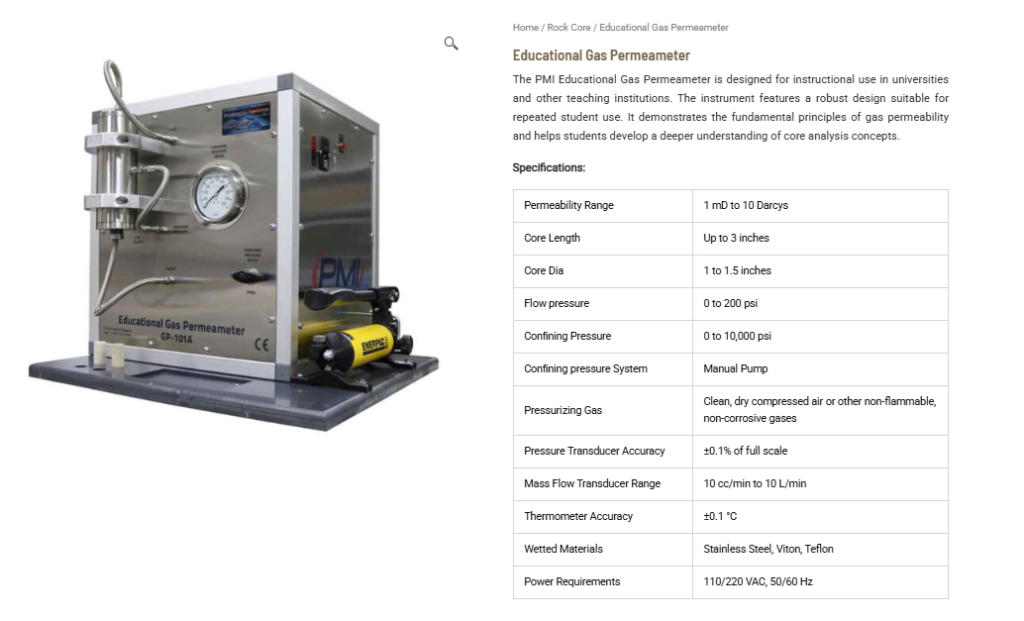
The Educational Gas Permeameter is made for teachers and students to use in classes or labs. You can use it right away and get good readings for gas permeability. This tool is strong and simple to use. Its controls are easy, so anyone can learn how to use it. The readouts are clear. This helps people learn more about gas permeability and how to test core samples.
What Is an Educational Gas Permeameter?
The Educational Gas Permeameter is a tool you use in the lab to see how gas moves through small pieces of rock. It is built to be used in college classes and labs where people learn. This system helps you find out how gas moves through things that have tiny holes. It also gives you the info you need about how easy it is for gas to move through them.
Its strong build and simple design make it good for classroom demos. You can also use it for lab work or other projects. This tool is helpful when you want to see what that rock is like.
Why Gas Permeability Matters
Gas permeability is one of the main things people look at when they want to see how well gas can move in or out of a spot under the earth. This shows you if the flow is good and what the gas can do in that place.
Accurate gas permeability measurements can help people in these jobs:
- See how good the reservoir is
- Look to see how fluids move
- Find out how much hydrocarbon can be made
- See how rocks are the same or different
- Help with simulation work
- Learn how the pores connect
Permeability testing gives students a good way to see one main idea in the field of engineering and petrophysics.
Key Features of the Educational Gas Permeameter
1. Wide Permeability Measurement Range
The system measures permeability values from:
1 mD to 10 Darcys
This wide measurement range lets people look at rocks that are packed close together. It also lets them check rock samples that can take in a lot of fluid.
2. High Confining Pressure Capability
The tool can show what happens deep under the earth. It can work with high pressures up to:
10,000 psi
This lets people try real tests in the lab. It also shows how the spot where the liquid stays acts when it gets strained.
3. Controlled Gas Flow Testing
The system uses clean and dry air. It can also work with other gases that do not burn. These gases do not hurt the metal. This means you can get safe results when you check how things go through materials. You can also do it fast.
4. Precision Measurement Technology
The Educational Gas Permeameter uses good sensors. These sensors are set up to give you the right data. This includes:
- The pressure transducer can read up to ±0.1% of full scale.
- The thermometer can read up to ±0.1°C.
These features help you get good and steady test results every time.
5. Flexible Core Sample Compatibility
The system accommodates rock core samples with:
- Core width: 1 to 1.5 inches
- Core size: Up to 3 inches
This helps people get to know things and find answers in many ways.
6. Manual Confining Pressure System
A manual pump pressure system helps students and people who do research see how pressure works in tests. The setup lets them watch the pressure and learn from it.
Technical Specifications
| Specification | Details |
|---|---|
| Permeability Range | 1 mD to 10 Darcys |
| Core Length | Up to 3 inches |
| Core Diameter | 1 to 1.5 inches |
| Flow Pressure | 0 to 200 psi |
| Confining Pressure | 0 to 10,000 psi |
| Confining Pressure System | Manual Pump |
| Pressurizing Gas | Clean, Dry Compressed Air or Other Non-Flammable, Non-Corrosive Gases |
| Pressure Transducer Accuracy | ±0.1% Full Scale |
| Mass Flow Transducer Range | 10 cc/min to 10 L/min |
| Thermometer Accuracy | ±0.1°C |
| Wetted Materials | Stainless Steel, Viton, Teflon |
| Power Requirements | 110/220 VAC, 50/60 Hz |
Educational Benefits of the Gas Permeameter
Hands-On Learning Experience
The Educational Gas Permeameter is a tool that helps students understand more than the simple points. It lets you see how gas enters and passes through rock with small holes.
Understanding Reservoir Fundamentals
Students gain practical knowledge of:
- Darcy’s Law
- Fluid flow that be in porous things
- Pressure that change
- Check the type of rock
- Ways to check how much passes through
Enhanced Laboratory Training
The instrument is a good tool for students in the lab. It is fun and easy to use in class. You can use it for group shows. It also works well in engineering classes.
Real-World Core Analysis Experience
The system lets students see how tests are done in labs for oil and earth science. This shows the way labs in many places do these tests.
Applications of the Educational Gas Permeameter
Petroleum Engineering Programs
Teach easy ways to see how liquids move in things. Talk about how fluids go from one place to another. Show how to find a good spot where liquids are kept.
Geological Research
Look at how gas moves through the rocks. See how easy it is for gas to pass through each one. Compare the way each rock lets gas move. Find out which rocks are better for letting the gas go through.
Core Analysis Training
Let people try lab permeability tests for themselves. They can do each step with their own hands.
Academic Research Projects
Get help to learn how fluids move in rocks with small spaces. Find out about rock traits and learn more about the place where fluids stay.
Technical Training Centers
Give hands-on demos that let people see how water moves below the ground and how the storage area works.
Advantages of the Educational Gas Permeameter
The system gives a lot of good things to schools and groups that do research. It helps them with work and gives new ways to get things done. Many people at these places find the system useful in their day-to-day tasks.
- Measures a wide range when checking permeability
- Good for high-pressure tests
- Tracks pressure and temperature well
- Safe for gas testing
- Made strong for many uses
- Easy way to get a sample set
- Works with different types of cores
- Simple to use in the lab
- Shows how permeability works for real
- Gives results you can trust every time
Why Choose the Educational Gas Permeameter?
The Educational Gas Permeameter is a good choice for schools and other places where you need a strong tool to test how gas moves in rocks. It gives results you can trust. The tool works under high pressure, and it is made for people who want to learn. Students use this tool to find out how gas moves in rocks deep under the earth.
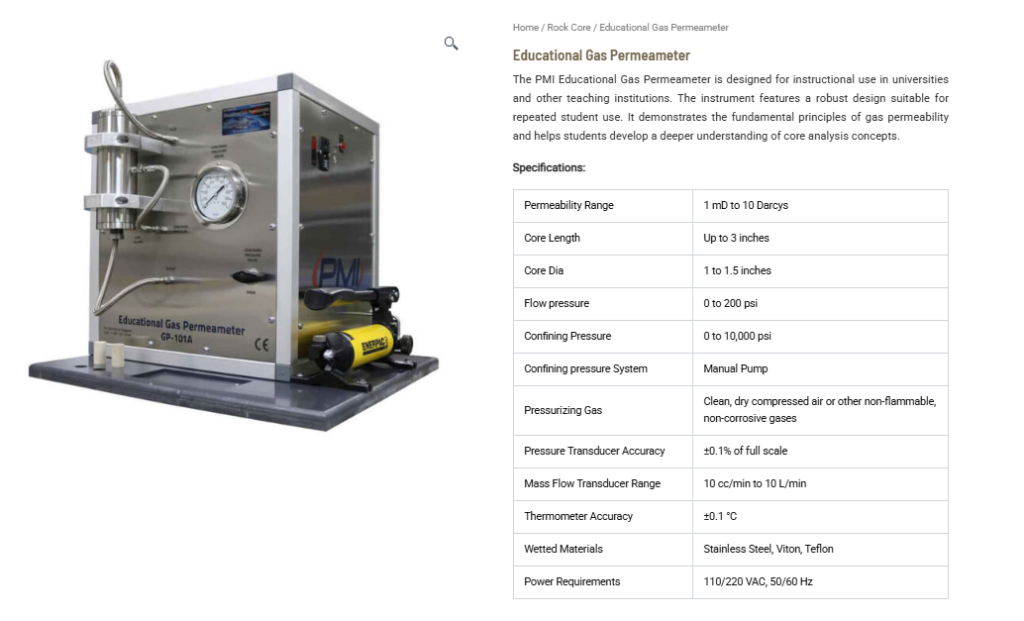
The Educational Gas Permeameter is a tool you can use in petroleum engineering, geological labs, and in settings where people learn technical skills. This tool helps people practice for real-life jobs. It also gives clear data on how gas moves through rocks. You can use it for research and school work.
POST BY : PMIAPP