
Introduction
Water scarcity, industrial wastewater management, and sustainable resource recovery have become some of the most pressing global challenges facing industries today. As governments implement stricter environmental regulations and organizations strive to improve operational efficiency, advanced separation technologies are becoming increasingly important. Among these innovations, Membrane Distillation (MD) has emerged as a highly promising solution for water purification, desalination, wastewater treatment, and industrial process optimization.
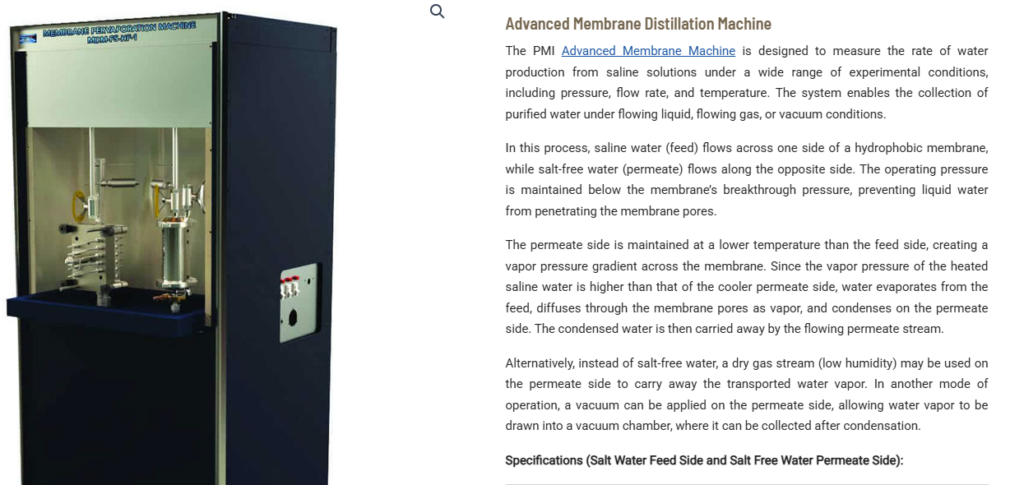
The PMI Advanced Membrane Distillation Machine is a state-of-the-art research and testing system specifically designed to evaluate water production from saline and contaminated feed solutions under controlled laboratory and pilot-scale conditions. By combining advanced membrane technology with precise control of temperature, pressure, and flow rates, the system enables researchers, engineers, universities, and industrial organizations to investigate membrane performance and optimize separation processes for a wide range of applications.
This article explores the principles, benefits, applications, and commercial value of membrane distillation technology while highlighting how the PMI Advanced Membrane Distillation Machine supports innovation in water treatment and membrane research.
Understanding Membrane Distillation Technology
Membrane Distillation (MD) is a thermally driven membrane separation process that utilizes a hydrophobic microporous membrane to separate water vapor from liquid feed streams.
Unlike traditional filtration technologies that rely on hydraulic pressure, membrane distillation uses a temperature difference between the feed side and permeate side of the membrane to create a vapor pressure gradient. This gradient serves as the driving force for water transport through the membrane.
The hydrophobic membrane prevents liquid water from entering its pores while allowing water vapor molecules to pass through. As a result, highly purified water can be recovered from saline, contaminated, or concentrated solutions.
This unique mechanism enables membrane distillation to process feed streams that may be difficult or impossible to treat using conventional membrane technologies such as reverse osmosis.
The Science Behind Membrane Distillation
To understand the effectiveness of membrane distillation, it is important to understand its operating principle.
Step 1: Heating the Feed Solution
A saline or contaminated feed solution is heated to a desired temperature. The increase in temperature raises the vapor pressure of water within the feed stream.
Step 2: Contact with Hydrophobic Membrane
The heated feed solution flows across one side of a hydrophobic membrane. The membrane acts as a barrier that prevents liquid water from penetrating the pores.
Step 3: Vapor Formation
At the membrane surface, water evaporates due to the temperature difference between the feed side and permeate side.
Step 4: Vapor Transport
The generated water vapor diffuses through the membrane pores.
Step 5: Condensation and Collection
Once the vapor reaches the cooler permeate side, it condenses into liquid water and is collected as purified permeate.
The result is highly purified water with exceptionally low concentrations of dissolved salts and contaminants.
Why Membrane Distillation is Different from Traditional Water Treatment Technologies
Many industries currently rely on technologies such as:
- Reverse Osmosis (RO)
- Multi-Stage Flash Distillation (MSF)
- Multi-Effect Distillation (MED)
- Ultrafiltration (UF)
- Nanofiltration (NF)
While these technologies have proven effective, they often face limitations when dealing with highly concentrated feed streams or challenging wastewater compositions.
Membrane distillation offers several unique advantages:
Higher Salt Concentration Tolerance
MD can process highly concentrated brines that would significantly reduce the efficiency of reverse osmosis systems.
Near-Complete Salt Rejection
The vapor transport mechanism provides extremely high salt rejection rates, often approaching 100%.
Lower Operating Pressure
Unlike RO systems that require high-pressure pumps, MD operates at relatively low pressures.
Reduced Mechanical Stress
Lower pressure operation results in reduced wear and longer equipment life.
Compatibility with Renewable Energy
The process can utilize solar thermal energy, geothermal heat, or industrial waste heat sources.
Introducing the PMI Advanced Membrane Distillation Machine
The PMI Advanced Membrane Distillation Machine has been developed to support advanced membrane research and process development.
The system is specifically engineered to measure water production rates from saline solutions under a wide range of operating conditions.
Researchers can investigate:
- Feed temperature effects
- Permeate temperature effects
- Pressure influence
- Flow rate optimization
- Membrane performance
- Water recovery efficiency
- Vapor transport mechanisms
- Membrane durability
- Fouling behavior
- Scale formation tendencies
This flexibility makes the system ideal for both academic research and industrial product development.
Key Features of the PMI Advanced Membrane Distillation Machine
Precision Temperature Control
Temperature is one of the most critical factors affecting membrane distillation performance.
The PMI system provides precise temperature regulation that allows users to study:
- Vapor pressure relationships
- Heat transfer behavior
- Water flux optimization
- Thermal efficiency
Accurate temperature control ensures highly reproducible experimental results.
Adjustable Flow Rate Control
Feed flow rate directly influences membrane performance and mass transfer characteristics.
The system allows researchers to:
- Analyze boundary layer effects
- Study concentration polarization
- Optimize circulation rates
- Improve process efficiency
Flow rates can be adjusted to simulate real-world operating conditions.
Advanced Pressure Monitoring
The machine supports operation across a wide pressure range while ensuring that membrane breakthrough pressure is not exceeded.
Benefits include:
- Safe operation
- Accurate data collection
- Flexible experimentation
- Membrane integrity protection
Multiple Operating Configurations
One of the most valuable features of the PMI Advanced Membrane Distillation Machine is its ability to support different operating modes.
Direct Contact Membrane Distillation (DCMD)
In DCMD, cooling water flows along the permeate side and directly condenses transported vapor.
Applications include:
- Water desalination
- Wastewater treatment
- Laboratory research
Air Gap Membrane Distillation (AGMD)
A stationary air layer is maintained between the membrane and condensation surface.
Benefits include:
- Reduced heat loss
- Improved thermal efficiency
Sweeping Gas Membrane Distillation (SGMD)
Dry gas carries water vapor away from the membrane surface.
Advantages include:
- Increased vapor transport
- Enhanced process flexibility
Vacuum Membrane Distillation (VMD)
Vacuum is applied on the permeate side.
Benefits include:
- Increased driving force
- Higher permeate flux
- Improved productivity
Technical Specifications
The PMI Advanced Membrane Distillation Machine offers robust operating capabilities suitable for demanding research environments.
| Parameter | Specification |
| Temperature Range | 5–85°C |
| Maximum Flow Rate | Up to 9.6 gallons/minute |
| Pressure Range | Up to 120 psi |
| Feed Type | Saline Solutions |
| Permeate Collection | Water, Gas, or Vacuum Modes |
| Membrane Type | Hydrophobic Membrane Systems |
These specifications provide researchers with extensive flexibility for process evaluation and optimization.
Applications of Membrane Distillation
Seawater Desalination
Freshwater demand continues to increase globally while freshwater resources become increasingly limited.
Membrane distillation offers:
- High salt rejection
- Superior water quality
- Treatment of highly saline water
- Reduced energy consumption when integrated with waste heat
The technology is increasingly being explored for sustainable desalination projects worldwide.
Industrial Wastewater Treatment
Many industrial sectors generate wastewater streams containing:
- Dissolved salts
- Heavy metals
- Organic contaminants
- Process chemicals
Membrane distillation can recover clean water while concentrating contaminants for further treatment or disposal.
Industries benefiting from MD include:
- Chemical manufacturing
- Textile processing
- Mining operations
- Petrochemical facilities
- Pharmaceutical production
Zero Liquid Discharge (ZLD)
Environmental regulations are pushing industries toward Zero Liquid Discharge systems.
MD supports ZLD objectives by:
- Maximizing water recovery
- Reducing wastewater volume
- Lowering disposal costs
- Improving sustainability metrics
Food and Beverage Processing
Membrane distillation can be used for:
- Concentration of juices
- Recovery of valuable ingredients
- Purification of process streams
- Water reuse initiatives
Pharmaceutical Manufacturing
Pharmaceutical facilities require exceptionally pure water and efficient separation processes.
Applications include:
- Solvent recovery
- Water purification
- Process stream treatment
- Product concentration
Mining Industry
Mining operations generate large volumes of highly saline wastewater.
MD technology helps:
- Recover usable water
- Reduce freshwater consumption
- Lower environmental impact
- Improve operational sustainability
Benefits for Research Institutions and Universities
The PMI Advanced Membrane Distillation Machine serves as an excellent platform for:
Membrane Development
Researchers can evaluate:
- New membrane materials
- Surface modifications
- Pore structures
- Coating technologies
Process Optimization
The system enables investigation of:
- Heat transfer dynamics
- Mass transfer mechanisms
- Flux enhancement strategies
- Energy efficiency improvements
Student Training
Universities can provide hands-on experience in:
- Membrane science
- Water treatment engineering
- Separation technology
- Environmental engineering
Benefits for Industrial Organizations
Industrial organizations use membrane distillation systems to:
Reduce Operating Costs
- Lower wastewater disposal expenses
- Recover valuable resources
- Improve water reuse
Improve Sustainability
- Reduce freshwater demand
- Minimize environmental impact
- Support ESG objectives
Increase Process Efficiency
- Optimize resource utilization
- Improve product quality
- Enhance operational reliability
Why Membrane Distillation is the Future of Water Treatment
Several global trends are driving the adoption of membrane distillation technology:
Growing Water Scarcity
Freshwater shortages continue to affect regions worldwide.
Increasing Industrial Water Demand
Industrial expansion is increasing pressure on water resources.
Stricter Environmental Regulations
Governments are enforcing tighter wastewater discharge requirements.
Focus on Circular Economy
Organizations are prioritizing water reuse and resource recovery.
Advances in Membrane Materials
New membrane technologies are improving efficiency and reducing costs.
These factors position membrane distillation as a key technology for the future of sustainable water management.
Why Choose the PMI Advanced Membrane Distillation Machine?
PMI has established itself as a trusted provider of advanced scientific instrumentation and membrane characterization systems.
The PMI Advanced Membrane Distillation Machine offers:
Exceptional Accuracy
Generate reliable and repeatable experimental data.
Flexible Operating Conditions
Study membrane performance under a broad range of conditions.
Comprehensive Research Capabilities
Evaluate thermal, hydraulic, and mass transfer effects simultaneously.
Industrial Relevance
Simulate real-world applications and operating environments.
User-Friendly Design
Designed for efficient laboratory operation and data collection.
Long-Term Reliability
Built using high-quality engineering and manufacturing standards.
Return on Investment for Research and Industry
Investing in a membrane distillation testing platform enables organizations to:
- Accelerate product development
- Improve membrane design
- Reduce research timelines
- Optimize process performance
- Increase water recovery rates
- Support commercialization efforts
For universities, research institutions, membrane manufacturers, and industrial process developers, the PMI system provides a powerful foundation for innovation.
Conclusion
Membrane distillation is rapidly becoming one of the most promising technologies for water purification, desalination, wastewater treatment, and resource recovery. Its ability to process highly concentrated feed streams, achieve near-complete salt rejection, and utilize low-grade heat sources makes it an attractive alternative to conventional separation technologies.
The PMI Advanced Membrane Distillation Machine provides researchers and industrial professionals with a sophisticated platform for studying, optimizing, and commercializing membrane distillation processes. With precise control over temperature, pressure, and flow conditions, the system supports cutting-edge research while helping organizations develop efficient, sustainable, and economically viable water treatment solutions.
As industries continue to pursue higher efficiency, improved sustainability, and greater water security, advanced membrane distillation systems will play a central role in shaping the future of separation technology and water resource management.
POST BY : PMIAPP