
Introduction
As industries worldwide face increasing challenges related to water scarcity, wastewater treatment, resource recovery, and sustainable manufacturing, advanced membrane-based separation technologies have emerged as powerful solutions. Among these technologies, Membrane Distillation (MD) and Pervaporation (PV) stand out for their ability to achieve highly efficient separation processes while consuming less energy compared to many conventional methods.
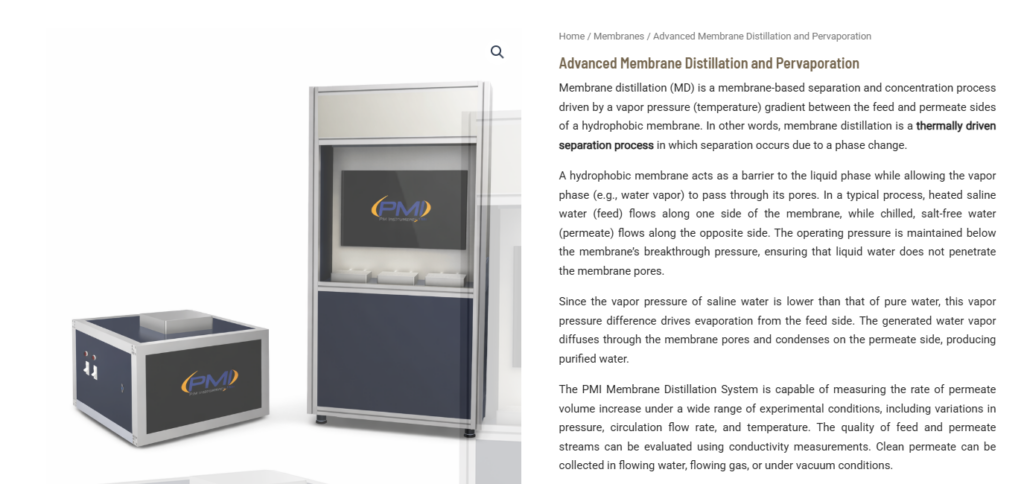
The PMI Advanced Membrane Distillation and Pervaporation System is designed to help researchers, engineers, universities, and industrial laboratories evaluate membrane performance under real-world operating conditions. This advanced platform provides accurate measurement and analysis capabilities for membrane separation applications ranging from desalination and wastewater treatment to solvent dehydration and chemical purification.
What is Membrane Distillation?
Membrane Distillation (MD) is a thermally driven membrane separation process that uses a hydrophobic membrane to separate water vapor from liquid solutions.
Unlike traditional pressure-driven membrane technologies such as reverse osmosis, membrane distillation relies on a temperature-induced vapor pressure gradient across the membrane. The membrane prevents liquid water from passing through while allowing water vapor molecules to travel through its porous structure.
How Membrane Distillation Works
The process typically involves:
- A heated feed solution flowing along one side of the membrane.
- A cooler permeate stream flowing on the opposite side.
- Water evaporation occurring at the warm feed interface.
- Water vapor passing through membrane pores.
- Condensation occurring on the cooler permeate side.
- Collection of purified water.
The driving force is the difference in vapor pressure created by the temperature difference between the feed and permeate streams.
Key Advantages of Membrane Distillation
High Salt Rejection
Membrane distillation can achieve nearly complete rejection of dissolved salts, making it ideal for desalination and brine concentration applications.
Ability to Treat Highly Concentrated Streams
Unlike reverse osmosis systems that experience limitations at high salinity levels, MD can effectively process highly concentrated solutions and industrial waste streams.
Lower Operating Pressure
The process operates at relatively low hydraulic pressures, reducing mechanical stress on system components.
Utilization of Low-Grade Heat
Waste heat, solar thermal energy, and other low-temperature heat sources can be used to drive the separation process, improving overall energy efficiency.
Superior Water Quality
The produced permeate is exceptionally pure, making it suitable for demanding industrial and laboratory applications.
Understanding Pervaporation Technology
Pervaporation is another membrane-based separation process used primarily for separating liquid mixtures.
In pervaporation, a liquid feed contacts a selective membrane. Specific components preferentially permeate through the membrane and evaporate on the opposite side under vacuum or sweep gas conditions.
Process Steps
- Liquid mixture contacts the membrane surface.
- Selected molecules dissolve into the membrane.
- Molecules diffuse through the membrane matrix.
- Components evaporate on the permeate side.
- Vapors are condensed and collected.
The separation mechanism depends on membrane selectivity and molecular transport properties.
Benefits of Pervaporation
Energy-Efficient Separation
Pervaporation often requires significantly less energy than traditional distillation processes.
Separation of Azeotropic Mixtures
Certain mixtures cannot be effectively separated through conventional distillation due to azeotrope formation. Pervaporation provides an efficient alternative.
Improved Product Purity
The technology enables high-purity product recovery in pharmaceutical, chemical, and food-processing industries.
Reduced Environmental Impact
Lower energy consumption contributes to reduced carbon emissions and improved sustainability.
PMI Advanced Membrane Distillation and Pervaporation System
The PMI Advanced Membrane Distillation and Pervaporation System provides researchers with a comprehensive platform for membrane characterization and process optimization.
The system is engineered to evaluate:
- Permeate production rates
- Membrane performance
- Separation efficiency
- Water recovery rates
- Conductivity measurements
- Temperature effects
- Pressure influence
- Flow rate optimization
- Long-term membrane stability
Researchers can simulate various operating conditions and collect highly accurate experimental data.
System Features
Precise Temperature Control
Temperature directly affects vapor pressure and separation performance. The system allows accurate temperature regulation across a broad operating range.
Adjustable Pressure Settings
Users can evaluate membrane performance under different pressure conditions to optimize separation efficiency.
Variable Flow Rates
Feed circulation rates can be modified to study mass transfer effects and membrane behavior.
Conductivity Monitoring
Real-time conductivity measurements help assess feed and permeate quality during experiments.
Multiple Collection Modes
Clean permeate can be collected under:
- Flowing water conditions
- Flowing gas conditions
- Vacuum conditions
This flexibility supports a wide variety of research applications.
Technical Specifications
Feed Characteristics
| Parameter | Range |
| Temperature | 5–90°C |
| Recirculation Flow Rate | 0.1–1 gallon/minute |
| Optional Flow Rate | Up to 10 gallons/minute |
| Pressure Range | 1–120 psi |
| Maximum Concentration | Up to 200,000 ppm (NaCl equivalent) |
| pH Range | 1.5–13 |
| Feed Tank Volume | 5 L standard, up to 50 L optional |
These specifications allow researchers to evaluate membrane performance under both standard and extreme operating environments.
Applications of Membrane Distillation
Desalination
Freshwater production from seawater and brackish water remains one of the most important applications of membrane distillation.
Benefits include:
- High salt rejection
- Lower fouling potential
- Treatment of hypersaline brines
- Compatibility with renewable energy systems
Industrial Water Recovery
Industries increasingly use MD to recover clean water from:
- Chemical processing wastewater
- Textile effluents
- Mining wastewater
- Pharmaceutical wastewater
- Food and beverage process streams
Zero Liquid Discharge (ZLD)
Membrane distillation supports ZLD strategies by maximizing water recovery while minimizing waste disposal volumes.
Applications of Pervaporation
Solvent Dehydration
Pervaporation is widely used to remove water from organic solvents such as:
- Ethanol
- Isopropanol
- Acetone
- Methanol
Chemical Processing
The technology helps separate complex chemical mixtures that are difficult or impossible to separate using traditional distillation.
Pharmaceutical Manufacturing
Pervaporation supports purification and recovery processes requiring high product quality and consistency.
Biofuel Production
Ethanol dehydration is a major application where pervaporation improves process efficiency while reducing energy consumption.
Why Membrane Distillation and Pervaporation Are the Future
Global industries are seeking solutions that offer:
- Lower energy consumption
- Higher process efficiency
- Better environmental sustainability
- Reduced operating costs
- Improved resource recovery
Membrane distillation and pervaporation address these challenges by combining advanced membrane science with practical industrial implementation.
As regulations surrounding water reuse, wastewater discharge, and sustainability become more stringent, these technologies are expected to play a critical role in future separation and purification systems.
Why Choose PMI for Membrane Research?
The PMI Advanced Membrane Distillation and Pervaporation System delivers:
✓ High-precision experimental data
✓ Flexible operating conditions
✓ Comprehensive membrane performance analysis
✓ Support for academic and industrial research
✓ Reliable conductivity and permeate measurements
✓ Scalable testing capabilities
✓ Advanced process optimization tools
Whether your focus is desalination research, wastewater treatment, membrane development, solvent recovery, or industrial process optimization, PMI’s advanced testing platform provides the accuracy and flexibility required for successful membrane characterization.
Conclusion
Advanced membrane distillation and pervaporation technologies are revolutionizing the way industries approach water purification, solvent separation, and resource recovery. By leveraging temperature-driven and selective membrane transport mechanisms, these processes offer efficient, sustainable, and highly effective alternatives to conventional separation methods.
The PMI Advanced Membrane Distillation and Pervaporation System empowers researchers and engineers to explore, evaluate, and optimize membrane performance under a wide range of operating conditions, helping accelerate innovation in water treatment, chemical processing, renewable energy, and environmental sustainability.
Looking to enhance your membrane research capabilities? Contact PMI today to learn how our Advanced Membrane Distillation and Pervaporation System can support your next breakthrough in separation technology.
POST BY : PMIAPP