
Table of Contents
Measuring Permeability in Tight Reservoirs with Confidence
As the energy industry looks more at new places to get gas, such as shale gas and tight gas, it needs better ways to find out how much gas or oil can move through rocks. Old ways to check this can take a lot of time. Also, they might not work well for rocks that are hard for gas to pass through.
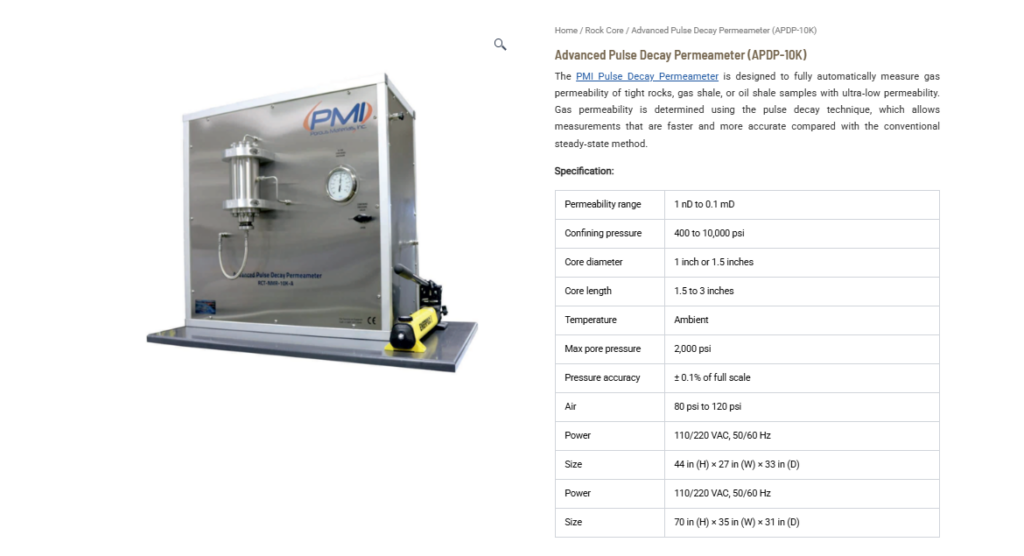
The Advanced Pulse Decay Permeameter (APDP-10K) is made to help with these problems. It gives fast and clear results for permeability tests. It is great for hard rocks, gas shale, and oil shale samples. The APDP-10K works using modern pulse decay methods. This lets people who do research or work in the field get good information about rocks that are very tight and hard to measure. They can trust the results to show how these rocks really are.
What Is the APDP-10K?
The Advanced Pulse Decay Permeameter (APDP-10K) is a lab tool that can work by itself. People use it to find out gas flow rates in small rock pieces that have low flow. The system uses pulse decay. This is a way many use to see how gas moves in rocks when other ways are slow or do not work well.
The APDP-10K is built for research labs, places that study petroleum engineering, and core analysis centers. It gives good permeability data. You need this data to look at the underground stone and to plan for oil and gas production.
Understanding Pulse Decay Permeability Measurement
Pulse decay testing is done by adding a small push of pressure to both sides of a rock sample. You then see how this pressure change gets less over time. How fast the pressure goes down tells us how easy it is for something to move through the sample.
Pulse decay methods have some good points when you look at them next to steady-state testing.
- The testing is done faster.
- The results are better for tight formations.
- Less gas is used.
- Tests give the same results every time.
- It picks up very small changes, so you can use it for ultra-low permeability measurements.
These benefits make pulse decay analysis the best way to look at and get more info about different types of oil or gas fields.
Key Features of the APDP-10K
1. Ultra-Low Permeability Measurement Capability
The APDP-10K is made to find permeability numbers. You can use it with values from:
1 nD to 0.1 mD
This range makes the system ideal for analyzing:
- Tight sandstone reservoirs
- Gas shale formations
- Oil shale samples
- Unconventional hydrocarbon resources
- Low-permeability core samples
2. High Confining Pressure Operation
To show what really happens under the soil, the system can give confining pressure from:
400 psi to 10,000 psi
This feature helps people do real lab tests. It also helps get better information about the storage area.
3. Automated Testing Process
The APDP-10K can do permeability measurements by itself. This means people do not have to do as much work. The test steps will stay the same every time.
Automation helps laboratories:
- Make things work better
- Move more work through
- Cut down human mistakes
- Make sure data can be done the same every time
4. High Pore Pressure Capability
The system supports maximum pore pressures up to:
2,000 psi
This lets researchers know how rocks act when they feel pressure. It is like what happens in a real spot where oil or gas is kept.
5. Precision Pressure Monitoring
The APDP-10K can give you good measurements with:
Pressure accuracy: ±0.1% of full scale
This level of being right is very important to get good permeability results in very tight rocks.
6. Flexible Sample Compatibility
The instrument accommodates core samples with:
- Core diameter: 1 inch or 1.5 inches
- Core length: 1.5 to 3 inches
This way of working helps you use it for many big jobs in analysis.
Technical Specifications
| Specification | Details |
|---|---|
| Permeability Range | 1 nD to 0.1 mD |
| Confining Pressure | 400 to 10,000 psi |
| Core Diameter | 1 inch or 1.5 inches |
| Core Length | 1.5 to 3 inches |
| Operating Temperature | Ambient |
| Maximum Pore Pressure | 2,000 psi |
| Pressure Accuracy | ±0.1% Full Scale |
| Air Supply | 80 to 120 psi |
| Power Supply | 110/220 VAC, 50/60 Hz |
| Dimensions | 44 in (H) × 27 in (W) × 33 in (D) |
Applications of the APDP-10K
Unconventional Reservoir Evaluation
The APDP-10K is good to use when you want to study shale and tight rock layers. These are places where fluid does not move much.
Gas Shale Research
Researchers can look at how gas moves and see how good the reservoir is in shale more easily now.
Core Analysis Laboratories
The people who work in commercial and research labs can give good and trusted permeability data. This is helpful for those in exploration and production projects.
Reservoir Engineering Studies
The tool is good for checking how easy it is for fluids to move through. People use it to predict production, plan how wells should be finished, and understand how things may flow in the ground.
Academic Research Programs
Universities and research institutions can use the system for higher-level studies in petrophysics and rock properties. It can also help with the development of oil and gas that is not found in normal places.
Benefits of Pulse Decay Technology
The pulse decay method has some good points when you look at it next to old ways to check how easy gas or liquid can go through something.
Faster Results
Testing can be done faster than staying at the same level. This lets the lab get more work done.
Improved Accuracy
This way works well for samples that have very low permeability. In these cases, normal ways do not give good results.
Better Reservoir Representation
High pressure around and inside rocks helps us create real models of deep oil and gas places underground.
Reduced Operating Costs
Using automated testing and using less gas help to lower the running costs. At the same time, the measurement stays good.
Why Choose the Advanced Pulse Decay Permeameter (APDP-10K)?
The APDP-10K uses new pulse decay tools. It runs on its own and handles high-pressure checks well. This helps make the APDP-10K a good tool when you need to test things that have very low flow. You can check tight rocks, gas shales, and other tough places to get a good read on what is there. Labs can use this tool for core testing jobs now.
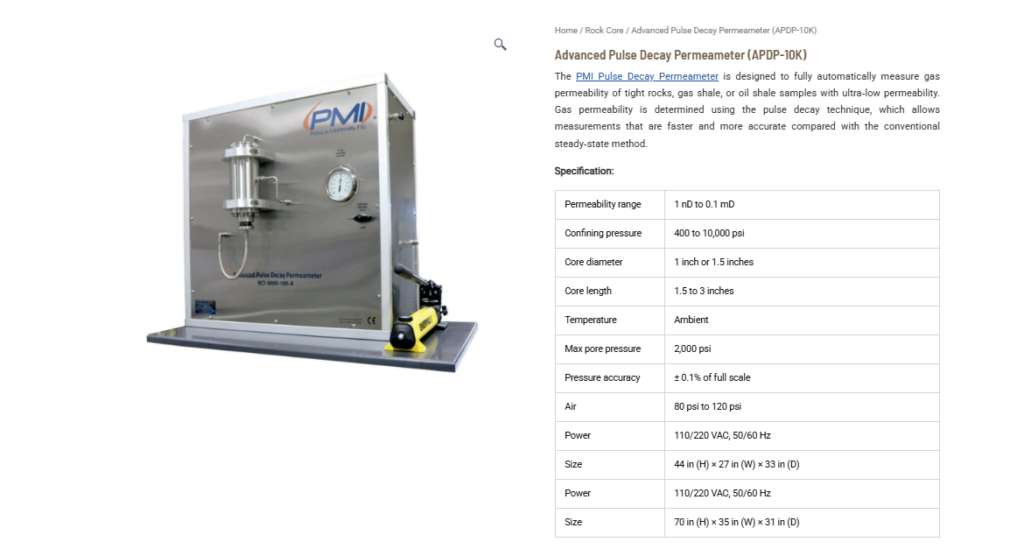
No matter if you help with building a reservoir, check new oil and gas spots, work on research for school, or do top-level petrophysical tests, the APDP-10K gives you the right results, speed, and trust you need for tough jobs in measuring permeability today.
BY: PMIAPP