
Introduction
Membrane technology has become one of the most important innovations in modern separation science, enabling efficient filtration, purification, concentration, and recovery processes across numerous industries. From water treatment and pharmaceutical manufacturing to biotechnology, food processing, gas separation, and medical applications, membranes play a critical role in improving efficiency, sustainability, and product quality.
Among the many membrane configurations available today, hollow fiber membranes are considered one of the most versatile and widely used formats due to their exceptionally high surface-area-to-volume ratio, compact design, and superior separation performance.
The ability to manufacture high-quality hollow fiber membranes with controlled pore structure, wall thickness, permeability, and mechanical strength is essential for advancing membrane science and developing next-generation filtration solutions.
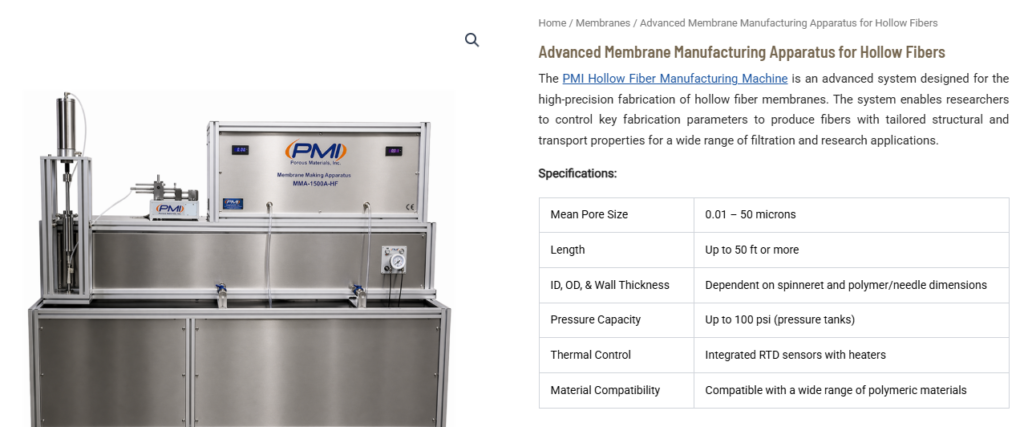
The PMI Advanced Membrane Manufacturing Apparatus for Hollow Fibers has been specifically engineered to provide researchers, universities, membrane manufacturers, and industrial laboratories with a sophisticated platform for producing hollow fiber membranes under precisely controlled conditions. By enabling complete control over critical fabrication parameters, the system allows users to develop and optimize hollow fiber membranes for a wide range of filtration and separation applications.
This comprehensive article explores hollow fiber membrane technology, manufacturing processes, industry applications, and the commercial benefits of the PMI Hollow Fiber Membrane Manufacturing System.
Understanding Hollow Fiber Membranes
Hollow fiber membranes are thin, tubular membranes with a hollow center through which fluids can flow. They are typically fabricated from polymeric materials and are designed to separate specific components from liquids or gases based on membrane pore size and material properties.
Unlike flat-sheet membranes, hollow fibers provide a significantly larger membrane surface area within a compact footprint. This makes them ideal for high-capacity filtration and separation processes.
A hollow fiber membrane consists of:
- An outer membrane wall
- A hollow internal channel (lumen)
- Controlled pore structures
- Selective separation layers
- Structural support layers
The geometry of hollow fibers enables highly efficient mass transfer while minimizing system size and operating costs.
Why Hollow Fiber Membranes Are Important
The increasing demand for advanced filtration and purification technologies has driven widespread adoption of hollow fiber membranes.
Their popularity stems from several advantages:
High Surface Area
Thousands of fibers can be packed into a single module, providing enormous membrane area within a compact volume.
Excellent Separation Efficiency
The unique structure enables efficient removal of contaminants, particles, microorganisms, and dissolved substances.
Scalability
Hollow fiber systems can be scaled from laboratory research to large industrial installations.
Cost Effectiveness
High productivity and compact design reduce operational costs.
Versatility
Hollow fiber membranes are suitable for liquid filtration, gas separation, biomedical applications, and industrial purification processes.
The Growing Global Market for Hollow Fiber Membranes
The global membrane technology market continues to expand rapidly due to:
- Increasing water scarcity
- Industrial wastewater regulations
- Growth in pharmaceutical manufacturing
- Expansion of biotechnology industries
- Demand for clean energy technologies
- Growth in gas separation applications
- Rising healthcare requirements
Hollow fiber membranes are now extensively used in:
- Water purification
- Wastewater treatment
- Hemodialysis
- Bioprocessing
- Gas separation
- Food and beverage processing
- Pharmaceutical manufacturing
- Hydrogen production
- Carbon capture systems
As demand increases, manufacturers require advanced fabrication systems capable of producing highly customized membranes with consistent quality and reproducibility.
The Science Behind Hollow Fiber Membrane Manufacturing
Manufacturing hollow fiber membranes is a highly sophisticated process that requires precise control of multiple variables.
The final membrane performance depends on:
- Polymer selection
- Solvent composition
- Bore fluid characteristics
- Spinneret design
- Extrusion conditions
- Coagulation bath composition
- Temperature control
- Pressure regulation
- Fiber take-up speed
Even small variations in these parameters can significantly affect membrane structure and performance.
Therefore, advanced manufacturing equipment is essential for producing reliable and reproducible hollow fiber membranes.
Introducing the PMI Advanced Membrane Manufacturing Apparatus for Hollow Fibers
The PMI Hollow Fiber Manufacturing Machine is designed to provide complete process control throughout membrane fabrication.
The system enables researchers to:
- Develop new membrane materials
- Optimize fiber morphology
- Control pore size distribution
- Modify membrane permeability
- Improve mechanical strength
- Enhance selectivity
- Study phase inversion dynamics
- Scale laboratory developments toward commercial production
The apparatus supports a wide variety of membrane research and development programs while maintaining excellent reproducibility.
Key Technical Specifications
The PMI Hollow Fiber Membrane Manufacturing Apparatus offers extensive fabrication capabilities.
Mean Pore Size
0.01 – 50 Microns
This broad range enables production of membranes suitable for:
- Microfiltration
- Ultrafiltration
- Specialized filtration applications
Fiber Length
Up to 50 Feet or More
Long fiber production capabilities support:
- Research projects
- Pilot-scale manufacturing
- Commercial process development
Internal Diameter, Outer Diameter, and Wall Thickness
Dimensions can be customized depending on:
- Spinneret configuration
- Polymer composition
- Needle dimensions
This flexibility allows researchers to tailor membrane characteristics to specific applications.
Pressure Capacity
Up to 100 PSI
High-pressure operation ensures stable polymer delivery and consistent fiber formation.
Thermal Control System
Integrated RTD sensors and heaters provide:
- Precise temperature regulation
- Improved process consistency
- Better membrane reproducibility
Material Compatibility
The system is compatible with a wide range of polymeric membrane materials.
Researchers can evaluate:
- PVDF
- PES
- PSU
- PAN
- Cellulose acetate
- Polyimide
- Advanced composite polymers
Advanced Features of the PMI Hollow Fiber Manufacturing System
Automated Polymer Mixing
Uniform polymer solutions are essential for producing consistent membrane structures.
The automated mixing system ensures:
- Controlled temperature conditions
- Homogeneous polymer distribution
- Reduced batch variability
- Improved membrane consistency
Proper mixing directly contributes to better pore structure and membrane performance.
Precision Pumping System
The system incorporates continuous stirring and precision pumping technology.
Benefits include:
- Stable polymer flow
- Uniform extrusion rates
- Reduced process fluctuations
- Improved fiber quality
Precise pumping ensures consistent membrane morphology throughout production.
High-Pressure Solution Delivery
Pressure-controlled tanks maintain stable operating conditions.
Advantages include:
- Consistent solution delivery
- Improved process reliability
- Enhanced fiber uniformity
- Better control over membrane properties
Integrated Coagulation System
One of the most critical stages in hollow fiber fabrication is phase inversion.
The PMI system includes a temperature-controlled coagulation bath where fibers enter immediately after extrusion.
This controlled environment enables:
- Precise pore formation
- Consistent membrane morphology
- Improved structural integrity
- Enhanced separation performance
Flow Regulation Technology
Advanced pneumatic flow controllers allow precise adjustment of:
- Polymer flow rates
- Bore fluid flow rates
- Extrusion conditions
This level of control is essential for tailoring membrane structure and transport properties.
Post-Processing Capabilities
The system includes:
- Washing tanks
- Fiber collection drums
- Cleaning stations
These components ensure proper handling and preparation of fabricated hollow fibers.
The Hollow Fiber Manufacturing Process
The PMI apparatus enables complete control of each manufacturing stage.
Step 1: Polymer Solution Preparation
Selected polymers are dissolved in appropriate solvents to create a homogeneous casting solution.
Step 2: Solution Mixing
The solution is continuously mixed to maintain consistency.
Step 3: Extrusion Through Spinneret
Polymer solution and bore fluid are simultaneously delivered through a specialized spinneret.
Step 4: Fiber Formation
As the polymer exits the spinneret, the hollow fiber structure begins to form.
Step 5: Coagulation
Fibers enter the coagulation bath where phase inversion occurs.
Step 6: Washing
Residual solvents are removed.
Step 7: Collection
Fibers are collected and prepared for testing or module fabrication.
Applications of Hollow Fiber Membranes
Water Treatment
Hollow fiber membranes are widely used for:
- Drinking water purification
- Wastewater recycling
- Desalination pretreatment
- Industrial water recovery
Their high packing density enables efficient large-scale operation.
Ultrafiltration Systems
Ultrafiltration membranes remove:
- Bacteria
- Viruses
- Suspended solids
- Colloidal contaminants
PMI enables development of advanced UF membranes with optimized performance.
Microfiltration Applications
Microfiltration membranes are used in:
- Food processing
- Beverage clarification
- Pharmaceutical production
- Biotechnology operations
Gas Separation
Hollow fiber membranes play a critical role in:
- Nitrogen generation
- Oxygen enrichment
- Hydrogen purification
- Carbon dioxide removal
- Natural gas processing
The PMI system enables development of next-generation gas separation membranes.
Medical Applications
Medical industries rely heavily on hollow fiber technology.
Applications include:
Hemodialysis
Artificial kidney systems utilize hollow fiber membranes to remove toxins from blood.
Blood Oxygenation
Membranes support extracorporeal oxygenation systems.
Bioprocessing
Biopharmaceutical manufacturers use hollow fibers for cell culture and purification.
Pharmaceutical Manufacturing
Hollow fiber membranes assist with:
- Sterile filtration
- Protein concentration
- Drug purification
- Biologic production
The PMI apparatus helps researchers develop specialized membranes for pharmaceutical applications.
Benefits for Research Institutions
Universities and research centers require flexible membrane fabrication systems.
The PMI Hollow Fiber Manufacturing Apparatus supports:
Membrane Material Development
Researchers can evaluate new polymers and composites.
Academic Research
Supports graduate and doctoral research projects.
Technology Innovation
Accelerates development of novel membrane technologies.
Process Optimization
Allows detailed study of fabrication parameters.
Benefits for Industrial Manufacturers
Industrial membrane producers benefit from:
Faster Product Development
Reduce development cycles and accelerate commercialization.
Enhanced Product Quality
Improve membrane consistency and performance.
Custom Membrane Design
Create membranes tailored to specific customer requirements.
Scale-Up Support
Bridge the gap between laboratory research and industrial production.
Emerging Trends in Hollow Fiber Technology
The membrane industry continues to evolve rapidly.
Key trends include:
Nanotechnology Integration
Nanomaterials are improving membrane performance and durability.
Anti-Fouling Membranes
Advanced surface modifications reduce fouling and maintenance requirements.
Smart Membranes
Responsive materials are enabling adaptive separation systems.
Sustainable Manufacturing
Researchers are developing greener fabrication processes and biodegradable materials.
Carbon Capture Applications
Hollow fiber membranes are increasingly used in greenhouse gas reduction technologies.
The PMI manufacturing system provides researchers with the tools needed to explore these emerging opportunities.
Why Choose PMI for Hollow Fiber Membrane Manufacturing?
PMI is recognized worldwide for developing advanced membrane characterization and manufacturing equipment.
The PMI Hollow Fiber Manufacturing Apparatus offers:
Comprehensive Process Control
Control every critical fabrication parameter.
Research-Grade Precision
Generate highly reproducible experimental results.
Flexible System Configuration
Support a wide variety of membrane materials and designs.
Industrial Relevance
Develop membranes suitable for commercial deployment.
Reliable Engineering
Built for long-term laboratory and pilot-scale operation.
Innovation Support
Accelerate research and product development initiatives.
Commercial Value of the PMI Hollow Fiber Manufacturing Apparatus
For organizations developing membrane technologies, the ability to produce custom hollow fibers in-house offers significant advantages.
These include:
- Reduced outsourcing costs
- Faster innovation cycles
- Intellectual property protection
- Improved product quality
- Greater process understanding
- Enhanced commercialization opportunities
The system provides an excellent return on investment by enabling efficient development of advanced membrane products.
Conclusion
Hollow fiber membranes are at the heart of many of today’s most important filtration, purification, and separation technologies. Their high surface area, exceptional efficiency, and broad application range make them indispensable across water treatment, biotechnology, healthcare, pharmaceutical manufacturing, gas separation, and industrial processing sectors.
The PMI Advanced Membrane Manufacturing Apparatus for Hollow Fibers provides researchers and manufacturers with a powerful, flexible, and highly precise platform for developing next-generation hollow fiber membranes. With advanced automation, precision control systems, integrated coagulation technology, and extensive material compatibility, the system enables complete optimization of membrane structure and performance.
Whether your goal is academic research, membrane product development, pilot-scale production, or commercial innovation, PMI’s Hollow Fiber Manufacturing Apparatus delivers the precision, reliability, and flexibility required to advance membrane technology and accelerate success in today’s competitive market.
POST BY : PMIAPP