
Table of Contents
Introduction
Airflow resistivity is an important thing to know about. It helps people find out how air moves through things with small holes. You will see this in many places, such as in sound, filtering, keeping things warm or cool, cars, planes, and science. This thing shows how easy it is for air to go in and out of something. Airflow resistivity can make a difference in how something deals with sound, stays warm or cool, filters air, and how good the finished product will be.
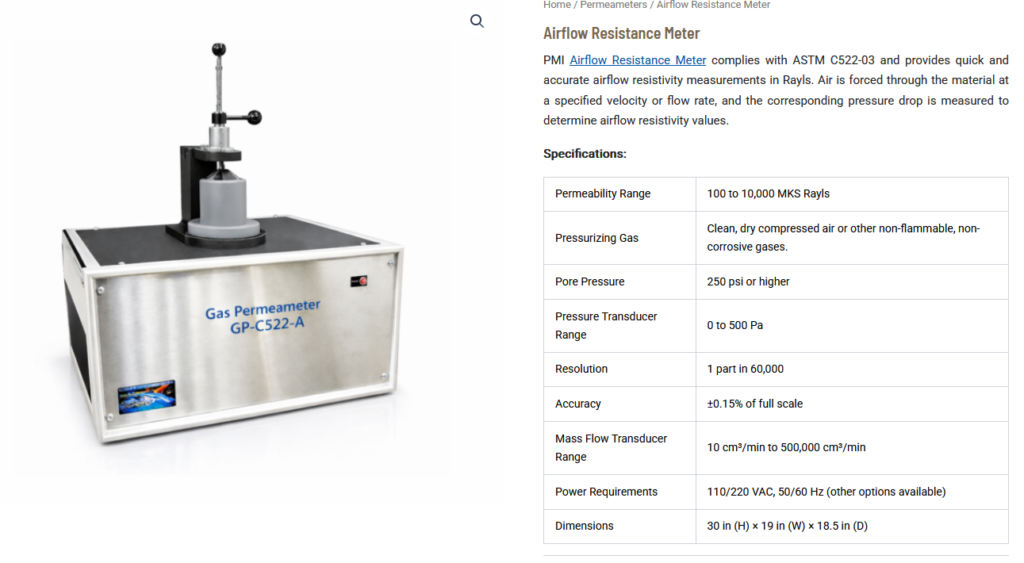
The PMI Airflow Meter is a tool that shows how easy it is for air to go through something. It works by the ASTM C522-03 rules. The meter sends air through a sample at a set speed. Then, it checks how the air pressure changes as it moves through the sample. With this, you get good and steady test results. You can see the answer in MKS Rayls.
Whether you use it in research, product development, or to test the quality, the Airflow Resistance Meter gives a good way to test porous materials. It will help you make things work better and meet rules and standards.
What is Airflow Resistivity?
Airflow resistivity tells you how much something pushes back when air moves through it. To measure this, people look at how the air pressure changes as air goes through the sample at a set speed.
This property is critical because it influences:
- How well it takes in sound
- How well it blocks noise
- How good it is at cleaning the air
- How air moves through it
- How easy it is for things to pass through
- How well it saves energy
- How it keeps heat in or out
Materials that have the right amount of airflow resistivity can help a lot with sound comfort. They also work well when you want things to be filtered in many situations.
Importance of Airflow Resistance Testing
Manufacturers and researchers do airflow tests to see if the materials fit the design and industry standards. This helps them know the materials are good for their work.
Testing helps:
- Make the good sound stuff work better.
- Make cleaning ways work better.
- Look at the holes inside things.
- Keep the thing good.
- Help with research and development.
- Make sure all industry rules are met.
Engineers can create good products when they have the right airflow data. This lets them know the things they build will work well in real life.
Overview of PMI’s Airflow Resistance Meter
The PMI Airflow Resistance Meter helps you get fast and good results for airflow resistivity. You can use it to see how air moves and be sure that your readings are correct every time.
The system operates by:
- First, the air is moved with care through the sample.
- Next, we see how much the pressure goes down.
- Then, we find the airflow resistivity values.
- Last, the results are given in MKS Rayls.
This easy way to test works well for many types of porous materials. It gives good results for them.
Compliance with ASTM C522-03
The Airflow Resistance Meter is made to follow ASTM C522-03. This is a well-known rule for seeing how much air goes through materials that block sound.
Compliance ensures:
- Regular testing steps
- Trustworthy data check
- Methods used by most in the industry
- Help for making sure of good quality
Organizations can feel sure when they use the instrument for certification, product validation, and research. They know it will work well for all these jobs.
Key Features of the Airflow Resistance Meter
Wide Measurement Range
The tool can check many kinds of materials. It will check for how much the airflow slows down in each one.
Airflow Resistivity Range
100 to 10,000 MKS Rayls
This range can work with many kinds of materials. People use these for sound and filtration.
High-Precision Pressure Measurement
Getting the right pressure readout is important. It helps you find out how the air flow slows down.
Pressure Transducer Range
0 to 500 Pa
This helps you see changes in pressure in the test samples in a clear way. So, you get results you can trust when you check airflow resistivity.
Exceptional Resolution
The Airflow Resistance Meter can give you a good feel when you measure.
Resolution
1 Part in 60,000
This high resolution helps you see even small changes in materials. It also lets you notice any difference between batches during production.
Excellent Measurement Accuracy
Good testing needs data that is steady and right.
Accuracy
±0.15% of Full Scale
This big level of being right helps in advanced research. It also helps with checking the quality in factories.
Advanced Airflow and Mass Flow Control
The tool has a smart way to check the amount of air moving through it. This lets it keep the airflow at the right level.
Mass Flow Transducer Range
10 cm³/min to 500,000 cm³/min
Benefits include:
- The airflow does not change.
- It is easy to check the airflow again and get the same number.
- You can use it for many different things.
- The airflow is measured in a good way.
This feature lets you test many materials. Some of these can have very different airflow.
Flexible Gas Compatibility
The Airflow Resistance Meter can use many kinds of gases to add pressure.
Compatible Gases
- The air should be clean, dry, and under pressure.
- The gases must not catch fire.
- The gases need to be safe and not harm people.
This way, laboratories can set up tests the way they need. It helps them fit each test for the task at hand.
High Pore Pressure Capability
Pore Pressure
250 psi or Higher
The system works well in hard places for testing. It keeps steady, and the results you get are right. You will have good and stable measurements every time.
Applications of Airflow Resistance Testing
Acoustic Materials
Airflow resistivity is very important when you make materials that let sound get in and help cut down noise.
Applications include:
- Sound foam
- Soundproof panels
- Car insulation
- Building sound treatment
- Studio sound materials
Filtration Media
Airflow can change how good the filter works.
Used for evaluating:
- Air filters
- HEPA filters
- Industrial filtration systems
- HVAC filtration materials
- Cleanroom filters
Thermal Insulation Materials
Testing helps optimize:
- Building insulation
- Industrial insulation
- Aerospace heat barriers
- Energy-saving materials
Automotive Industry
Manufacturers check how air moves for:
- Cabin sound materials
- Engine space insulation
- HVAC systems
- Noise lowering parts
Aerospace Applications
Airflow resistivity testing helps with the development of:
- Lightweight sound materials
- Heat and sound systems for aircraft
- A new way to mix and use different materials in structures
Research and Development
Universities and labs use airflow tests to see:
- Porous stuff
- New sound structures
- Good filters
- How stuff lets things pass through
Technical Specifications
| Specification | Details |
|---|---|
| Airflow Resistivity Range | 100 to 10,000 MKS Rayls |
| Pressurizing Gas | Clean, Dry Compressed Air or Other Non-Flammable, Non-Corrosive Gases |
| Pore Pressure | 250 psi or Higher |
| Pressure Transducer Range | 0 to 500 Pa |
| Resolution | 1 Part in 60,000 |
| Accuracy | ±0.15% Full Scale |
| Mass Flow Range | 10 cm³/min to 500,000 cm³/min |
| Power Requirements | 110/220 VAC, 50/60 Hz |
| Dimensions | 30 in (H) × 19 in (W) × 18.5 in (D) |
Benefits of PMI’s Airflow Resistance Meter
ASTM-Compliant Testing
It gives good and steady readings. These readings follow the ASTM C522-03 standards.
High Accuracy and Resolution
It helps you get results you can trust for research and in industry.
Broad Measurement Capability
Good to use with many kinds of soft materials. It also works well when there is different airflow.
Fast and Repeatable Testing
Helps the lab do work in a good way and make sure the quality stays right.
Flexible Application Support
This is good for the fields of sound, cleaning the air, keeping heat in or out, cars, planes, and learning about things in science.
Why Choose PMI’s Airflow Resistance Meter?
PMI is known around the world for making tools that help test and measure how air or other gases can get through something. The Airflow Meter is built well. It follows industry rules and uses up-to-date ways to measure. You can depend on it to give you good information about how much air goes through a thing.
Key advantages include:
- Meets ASTM C522-03 rule
- Has high measurement accuracy
- Has a wide airflow resistivity range
- Uses advanced pressure reading
- Has very fine detail
- Results stay the same each time
- Fits both research and work settings
Conclusion
The PMI Airflow Resistance Meter lets you check how much air goes through stuff with small holes. It is made to meet ASTM C522-03 rules. This tool shows clear pressure drop readings, collects easy-to-read data, and gives steady airflow numbers.
No matter if you check sound materials, filter stuff, insulation, or new open-structured things, the Airflow Resistance Meter always gives you the right results. It gives you steady and strong performance for today’s product checks and helps make sure the quality is good.