
Table of Contents
Introduction
Understanding how rocks stretch and hold up is very important in oil searching, land work, mining, keeping carbon, and in school research. Measuring how fast sound waves move through rock samples gives us good ideas about tiny holes in the rock, how water and gas move, how strong the rocks are, and how an oil or gas place will act.
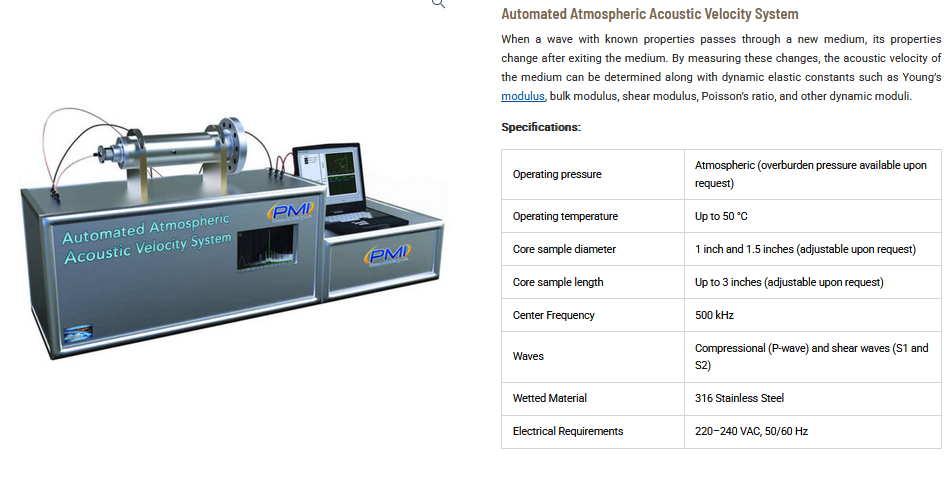
The Automated Atmospheric Acoustic Velocity System (AAVS) from PMI is a leading platform for testing. It is built to check how fast compressional and shear waves move in core samples at normal air pressure. The system uses high-end ultrasonic parts. With AAVS, researchers can find key details like Young’s Modulus, Bulk Modulus, Shear Modulus, and Poisson’s Ratio. This system works well and gives the same results every time.
What is an Automated Atmospheric Acoustic Velocity System?
An Automated Atmospheric Acoustic system is a tool people use in labs. It helps you see how sound waves move through solid things. These could be rock cores, things with small holes, ceramics, and things people make.
When a wave with details we know moves into a sample, the wave’s speed, height, and way it moves will change. The changes are there because of the sample’s own physical and mechanical features. When people watch these changes, they can learn about what is inside the sample and how it responds when force is put on it.
The PMI AAVS works by itself. It gives you quick and clear measurement of sound. You do not have to do a lot, so there is less work for people.
Understanding Acoustic Velocity Measurements
Acoustic speed testing is used a lot in earth science and other fields that work with things from the ground. It is one way people learn about the earth and things made from it.
The system measures two primary wave types:
Compressional Waves (P-Waves)
P-waves are waves that travel in a straight line. They move in the air, water, or on the ground by pushing and pulling the small pieces in the same way the wave moves.
P-wave measurements help determine:
- Rock density and how it connects to other things
- Bulk modulus
- Elastic properties
- How strong the rock layers are
- A look at the traits of the rock layers
Shear Waves (S-Waves)
S-waves shake things at a right angle compared to the way the wave moves.
These measurements provide information about:
- Shear modulus
- Mechanical strength
- Rock stiffness
- Cracking behavior
- Changing shape features
When you bring together P-wave data and S-wave data, you can get many important numbers for engineering and work related to land and rocks.
Importance of Acoustic Velocity Analysis
Testing how quick sound moves is important. It helps people know how things act in different times.
Reservoir Characterization
Oil and gas engineers use sound speed data to check:
- Quality of the rock layers
- Changes in pore space
- How the area is not the same everywhere
- Amount of fluid and what it does
- Strength and features of the rock
Geotechnical Engineering
Velocity measurements assist in:
- Foundation design
- Tunnel construction
- Slope stability check
- Soil condition check
Carbon Capture and Storage (CCS)
Researchers use acoustic data to evaluate:
- CO₂ storage formations
- Caprock strength
- Long-term storage safety
- Location monitoring
Mining Applications
Acoustic testing helps identify:
- Rock strength
- Break zones
- Structural weaknesses
- Finding out what the land offers
Dynamic Elastic Properties Determined by the System
One good thing about the Automated Atmospheric Acoustic Velocity System is that it can find out moving elastic constants.
Young’s Modulus
Young’s Modulus shows us how stiff something is. It tells us how tough it is to change its shape when you put force on it.
Applications include:
- Structural design
- Mechanical analysis
- Comparing different types of things you use
Bulk Modulus
Bulk Modulus tells us how much a thing can take when it is squeezed from all sides at the same time.
It is particularly important in:
- Reservoir engineering
- Fluid-rock interaction studies
- Geomechanics
Shear Modulus
Shear Modulus tells us how much a rock can hold up when something pushes or pulls on it. It lets us know how strong or hard the rock is.
Poisson’s Ratio
Poisson’s Ratio shows how the shape of something changes on the sides when you pull or press it on one end.
It is widely used in:
- Geomechanical modeling
- Simulations for the area where oil or gas is kept
- Looking at the structure
Key Features of PMI’s Automated Atmospheric Acoustic Velocity System
Fully Automated Operation
The system automates:
- Wave generation
- Signal getting
- Data processing
- Speed calculations
- Result storage
This makes things work better. It also helps cut down mistakes people make.
Simultaneous P-Wave and S-Wave Analysis
The AAVS looks at compressional and shear wave speeds. This lets us know more about the sample and what it can do.
High-Frequency Ultrasonic Testing
Center Frequency
500 kHz
The high-frequency transducers help us get a clear look at samples. They can also make it easy to know the speed of different samples.
Atmospheric Testing Environment
The standard setup works when the air pressure is normal. This helps you get the samples set up fast and test them easily.
You can ask to add overburden pressure features if you need them for more studies.
Robust Stainless-Steel Construction
All wetted components are manufactured from:
316 Stainless Steel
Benefits include:
- Does not rust easily
- Lasts for a long time
- Can work with many chemicals
- Works well and is steady
Technical Specifications
| Specification | Details |
|---|---|
| Operating Pressure | Atmospheric (Overburden Pressure Available Upon Request) |
| Operating Temperature | Up to 50°C |
| Core Sample Diameter | 1 inch and 1.5 inches (Adjustable Upon Request) |
| Core Sample Length | Up to 3 inches (Adjustable Upon Request) |
| Center Frequency | 500 kHz |
| Wave Types | Compressional (P-Wave) and Shear Waves (S1 & S2) |
| Wetted Material | 316 Stainless Steel |
| Electrical Requirements | 220–240 VAC, 50/60 Hz |
Applications of the Automated Atmospheric Acoustic Velocity System
Oil and Gas Industry
The system is extensively used for:
- Reservoir study
- Petrophysical exam
- Rock study
- Formation exam
- Core exam
Academic Research
Universities and research places use sound speed tests for:
- Geological studies
- Research in science about things people use
- Studies about how the earth works
- Teaching earth science
Carbon Sequestration Research
Acoustic measurements help monitor:
- Safe reservoirs
- Good storage
- CO₂ movement
- Strong ground support
Mining and Mineral Exploration
Researchers can evaluate:
- Ore body traits
- Rock strength
- Structure strength
- Crack development
Construction and Infrastructure
The system supports:
- Geotechnical checks
- Site checks
- Foundation checks
- Engineering stuff check
Benefits of Automated Acoustic Velocity Testing
High Accuracy
Advanced use of ultrasonic helps to get quick and steady speed numbers.
Rapid Data Collection
Automated testing lets you use less time to check things. It is good for getting your work done faster.
Improved Research Efficiency
Integrated software helps you get data. It also lets you understand it.
Comprehensive Material Characterization
At the same time, when we look at P-waves and S-waves, we can check mechanical and elastic parts closely.
Reliable Results
Automation lowers the number of changes. It makes tests stay the same each time.
Why Choose PMI’s Automated Atmospheric Acoustic Velocity System?
PMI is known around the world for giving good tools for testing things with pores, membrane features, filter science, and rock checks.
The Automated Atmospheric Acoustic Velocity System gives you:
- High-level ultrasonic measurements
- Automated testing and checking
- Measures changes in how samples bend and stretch
- Strong laboratory-grade build
- Works with many types of samples
- Reliable performance that lasts
These features make it a good option for labs, universities, energy companies, and research groups around the world.
Conclusion
The Automated Atmospheric Acoustic Velocity System (AAVS) is a strong tool that helps to find out how waves move in rock and other things. It shows how sound travels in these materials. The AAVS gives real readings for P-wave and S-wave speeds. This helps people who study rocks to know more about how rocks act, how good reservoirs are, and how safe the structures can be.
Whether you use it in petroleum research, geotechnical work, mining, or studies in school, PMI’s AAVS gives you the right tools. It is easy to use, works by itself, and you can trust it. This helps people do better work in science and engineering.
POST BY : PMIAPP