
Introduction
Knowing about the pore structure is important to find out how well porous materials can do their job. This is true in many fields like filters, medicine, ceramics, and also in biotechnology. If you understand the real pore size and how things move through it, it helps with research work, testing how good things are, and making new ideas into products.
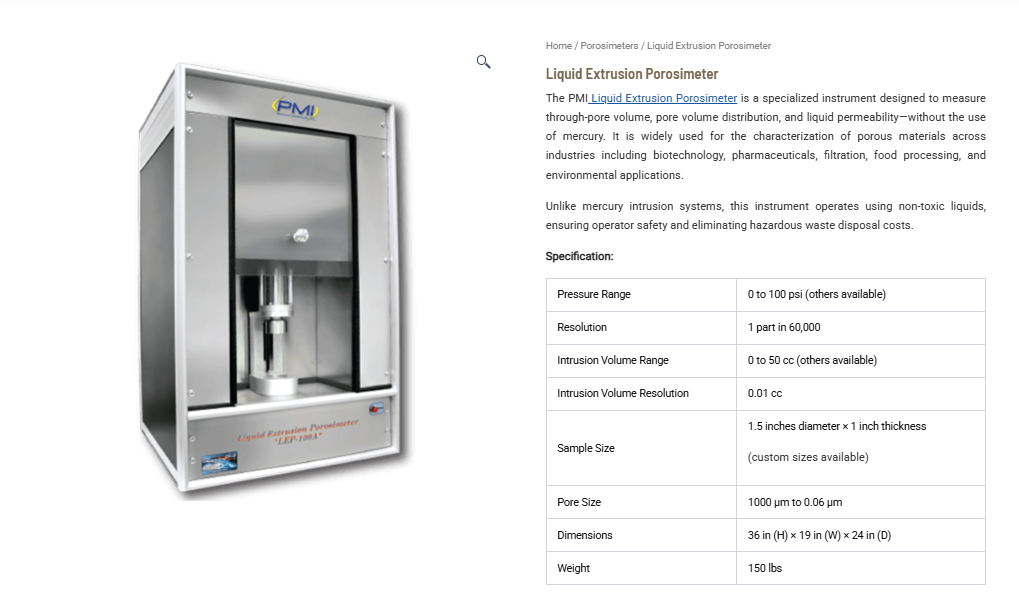
The Liquid Extrusion Porosimeter (LEP) gives a safe and green way to look at pore structure. It does not use mercury like the old porosimeters. Instead, it works with safe liquids to find out the through-pore volume, the size range of pores, and how liquids go through materials. With this method, there are no health or earth risks from mercury.
What is a Liquid Extrusion Porosimeter?
A Liquid Extrusion Porosimeter is a tool that lets people find the size of pores in things that have many tiny holes. It works by checking how much liquid comes out of a wet item when you push on it with pressure. This way, you can get the right details about the pores inside the sample.
The system evaluates:
- Through-pore space
- Pore size spread
- How easily liquid passes through
- Pore structure that works
- How the stuff moves
This way uses safe and not harmful liquids. It gives good and steady results. It also keeps the person safe when using it. Plus, it helps lower the cost for getting rid of waste.
How Does Liquid Extrusion Porosimetry Work?
The Liquid Extrusion Porosimeter is easy to use. First, you put a wet liquid over the sample. Then, you use gas pressure on it in a set way.
Testing Procedure
- The sample gets soaked with a liquid.
- The sample is put in the test chamber.
- Pressure is added slowly, one step at a time.
- When pressure goes up, the liquid comes out from the pores.
- The tool checks how much liquid comes out.
- A software is used to know the pore size and how easy it is for liquid to move through.
This way, you can see how all the small pores are linked to each other. You do not harm the sample when you do this. It helps you get clear results and keep the sample safe.
Key Features of the Liquid Extrusion Porosimeter
Mercury-Free Operation
The system does not use mercury. This makes testing safer for people. It also helps protect the environment.
High Measurement Resolution
The instrument has a resolution of 1 part in 60,000. It gives very exact measurements for pore structure. You can trust the numbers to be the same each time you use it.
Wide Pressure Range
The adjustable pressure range lets you test many kinds of materials. You can use this for things that have different pore sizes. It also helps you see how well they let other things move through them.
Accurate Volume Measurement
The advanced sensing system helps you get the right values for what comes in and what goes out.
Flexible Sample Compatibility
This tool is good for all types of sample sizes. You can set it up in many ways, so it works for many testing needs.
User-Friendly Operation
The automated testing process helps the lab collect and see data with ease. This lets the lab finish more work in less time.
Technical Specifications
| Parameter | Specification |
|---|---|
| Pressure Range | 0 to 100 psi (others available) |
| Resolution | 1 part in 60,000 |
| Intrusion Volume Range | 0 to 50 cc (others available) |
| Intrusion Volume Resolution | 0.01 cc |
| Sample Size | 1.5-inch diameter × 1-inch thickness |
| Pore Size Range | 1000 µm to 0.06 µm |
| Dimensions | 36 in (H) × 19 in (W) × 24 in (D) |
| Weight | 150 lbs |
Applications of Liquid Extrusion Porosimetry
Filtration Industry
It looks at the pore size range and how well things go through the filter materials and membranes.
Pharmaceutical Manufacturing
This study looks at porous tablets. The work is about drug delivery systems. It also checks medical-grade materials.
Biotechnology Research
This helps you learn more about things like biological scaffolds. It is also good for finding out about tissue engineering materials and separation media.
Food and Beverage Processing
It checks how well porous materials work when used in filters and processing systems.
Environmental Engineering
It helps to make new filtration systems and tools that cut down on pollution. These systems be made to keep the air and water clean.
Advanced Materials Research
It gives you good data about pore structure. You can use it for ceramics, polymers, foams, and composite materials.
Advantages Over Mercury Intrusion Porosimetry
Old mercury methods have been used for a long time to check pores. But, these tests have many limits.
Liquid Extrusion Porosimeter Benefits:
- Mercury-free testing
- Safer laboratory operation
- Less harm to the environment
- Lower cost to get rid of harmful waste
- Testing does not damage the sample
- Very good repeat results that are close together
- Can be used for many types of porous materials
Here are some good reasons why many labs like to use liquid extrusion porosimetry now. People working in labs today find it to be a better choice.
Why Choose a Liquid Extrusion Porosimeter?
Organizations that want to know more about pore structure but do not want the danger of mercury can use liquid extrusion tools. This tool gives safety, good results, and is easy to use. It can also give details about pore volume, how things move through, and the size range of the pores.
It can be used for many things. It can measure a wide range. So, this product is a good choice for research places. Labs in factories can also use it. Places that check the quality of things may want to use it too.
Conclusion
The Liquid Extrusion Porosimeter is a good and safe tool to test porous materials. It uses liquids that do not have poison and new ways to measure. With this, you get pore size, how much can go through, and flow data. All this is done without any risk that comes from mercury methods.
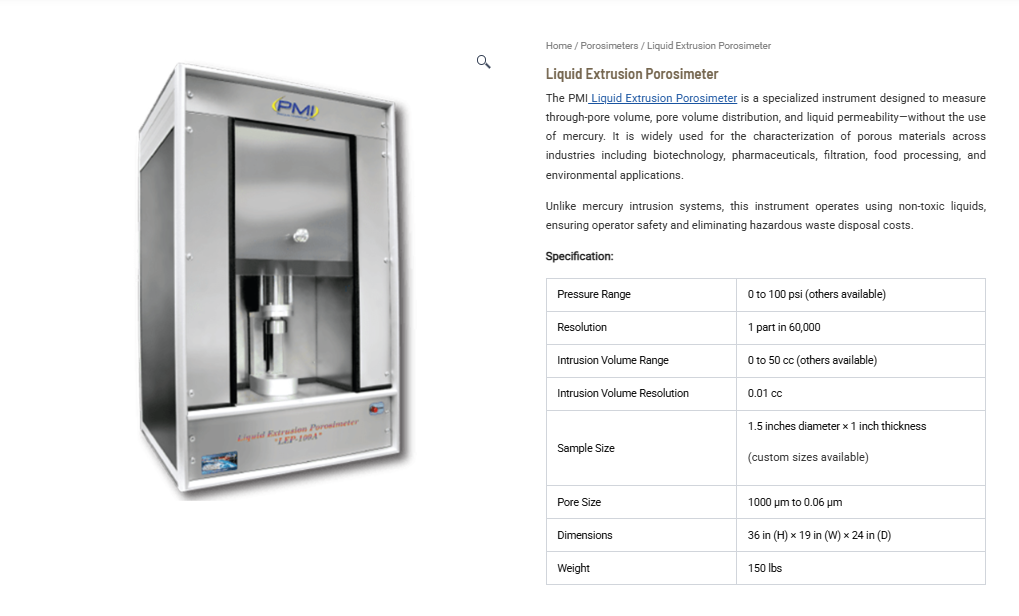
The Liquid Extrusion Porosimeter works well for labs that want to be safe and careful. It also helps those that follow the latest rules about the environment. This tool gives a clear view of the pore structure.
BY: PMIAPP