
Understanding the Importance of Porosity Measurement
Porosity is an important thing to know about when people look at oil and gas, rocks, and soil samples. It tells us how much open space there is inside the rock. This open space is key because it shows how much water or gas can stay or move through the rock. It is good to measure porosity in the right way. This helps people study oil and gas fields, water places, carbon storage areas, and rocks for many uses.
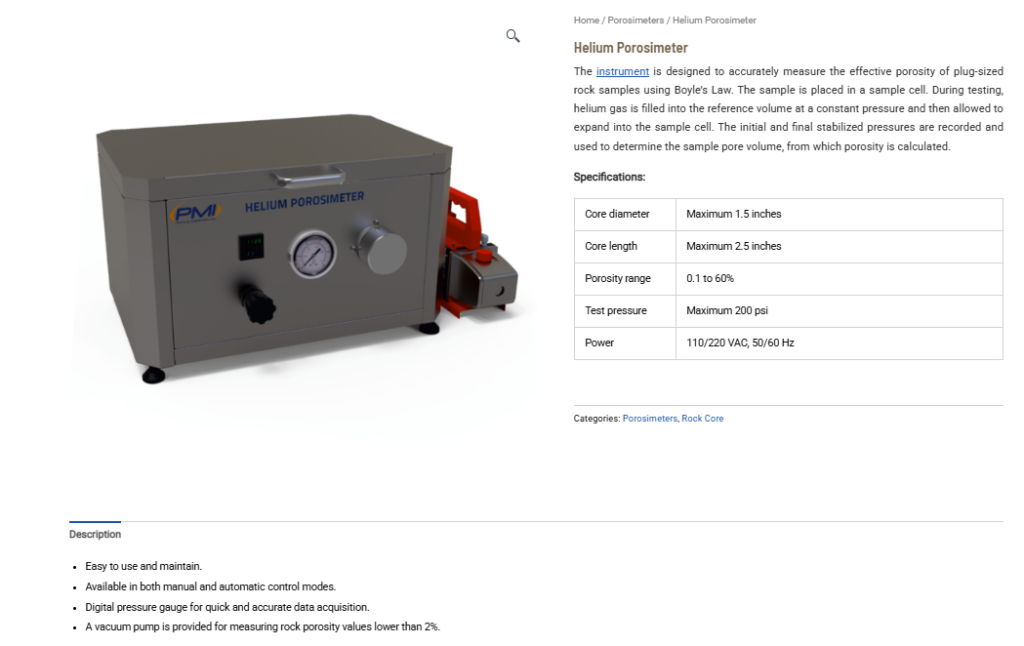
A Helium Porosimeter is a tool that you use in the lab to measure the open space, or pores, in rock core samples. It works with helium gas and Boyle’s Law. Helium is a very small atom, and it does not react with anything else. Because of this, it can move into tiny spaces in the rock easily. This lets people get good and steady numbers for the open space in the rock.
What is a Helium Porosimeter?
A Helium Porosimeter is a tool that people use to find out about the open space in small rock pieces. This open space is called pore space. The tool works by putting helium gas into a chamber. The gas is kept at a set pressure. After this, the gas moves into another chamber. This second chamber is where the rock sample is kept.
The instrument looks at the pressure before and after the gas moves out. This way, it finds the space with pores in the sample. Next, it looks at how much space in the rock has pores by looking at the pore space along with the whole rock size. Then, it shows this as a number to show what part of the rock has pores in it.
This way of testing does not damage anything. It also gives good results. People use it a lot in oil labs, places for research, colleges, and groups who study the land.
Working Principle of Helium Porosimetry
The Helium Porosimeter helps to measure by using Boyle’s Law. This law says that if the temperature stays the same, when the pressure of a gas gets higher, the volume gets smaller. So, if you change one of them, the other will change too, but in a different way.
Testing Process:
- A rock core sample is put in the sample chamber.
- Helium gas goes into the reference chamber at a set pressure.
- The gas then moves into the sample chamber.
- The tool notes down the first and last steady pressures.
- The tool shows the grain volume and the pore volume.
- The real porosity shows on the screen on its own.
Helium can move into very small spaces, so you get better results than many other ways to find out how much empty space something has.
Key Features of the Helium Porosimeter
High Measurement Accuracy
The instrument gives clear results on pore size and how many pores there are. It does this by using new pressure sensors.
Manual and Automatic Operation
You can get this in both manual and automated modes. So, you can choose what you need for your lab.
Digital Pressure Monitoring
The digital pressure gauge helps you read pressure well. It also lets you collect data you can trust.
Vacuum-Assisted Testing
A built-in pump helps to measure rock samples. It works with rocks where there is less than 2% porosity. This way, people can get better results when working with tight formations.
User-Friendly Design
It is easy to use and does not need much care. This makes it good for routine lab tests.
Technical Specifications
| Parameter | Specification |
|---|---|
| Core Diameter | Maximum 1.5 Inches |
| Core Length | Maximum 2.5 Inches |
| Porosity Range | 0.1% to 60% |
| Test Pressure | Maximum 200 PSI |
| Power Supply | 110/220 VAC, 50/60 Hz |
Applications of Helium Porosimeter
Oil and Gas Industry
You can use this to learn more about the storage. It helps you know how much you can take out and see the layer.
Core Analysis Laboratories
Gives the right porosity numbers for the geological and petrophysical studies.
Academic and Research Institutions
It helps people with research in rock study. It also shows how rocks move and break. This tool helps us see how things move through small spaces in the rocks.
Carbon Capture and Storage (CCS)
It helps you see what is below the ground. This is important for projects that put carbon dioxide there.
Groundwater and Environmental Studies
It helps people see how fluids move in rocks and soil under the earth.
Advantages of Using Helium Gas
Helium is used a lot for porosity tests. People use this gas because it can give good results.
- It does not react with other things and will not change.
- Its small size lets it move into very small holes.
- You get the same results each time you use it.
- It helps lower mistakes when you measure.
- You can use it for many kinds of rocks.
Why Choose a Helium Porosimeter?
Measuring porosity in the right way is key when you want to make good choices in development and studies of rocks underground. A Helium Porosimeter is a fast, trusted, and non-destructive tool. It helps you get the results you need and makes sure you can count on them.
It has a smart design and digital tracking. It uses a vacuum to help with tests. You can use it to look at many things. This tool is good for labs that need steady and good rock core results.
Conclusion
The Helium Porosimeter is a device that people use to find out how much space is inside rock samples. It works by using Boyle’s Law and the special qualities of helium gas. The tool gives clear results that people can count on. Many use it in petroleum engineering, earth studies, environmental work, and other sciences. It helps them make good choices in their work or studies.
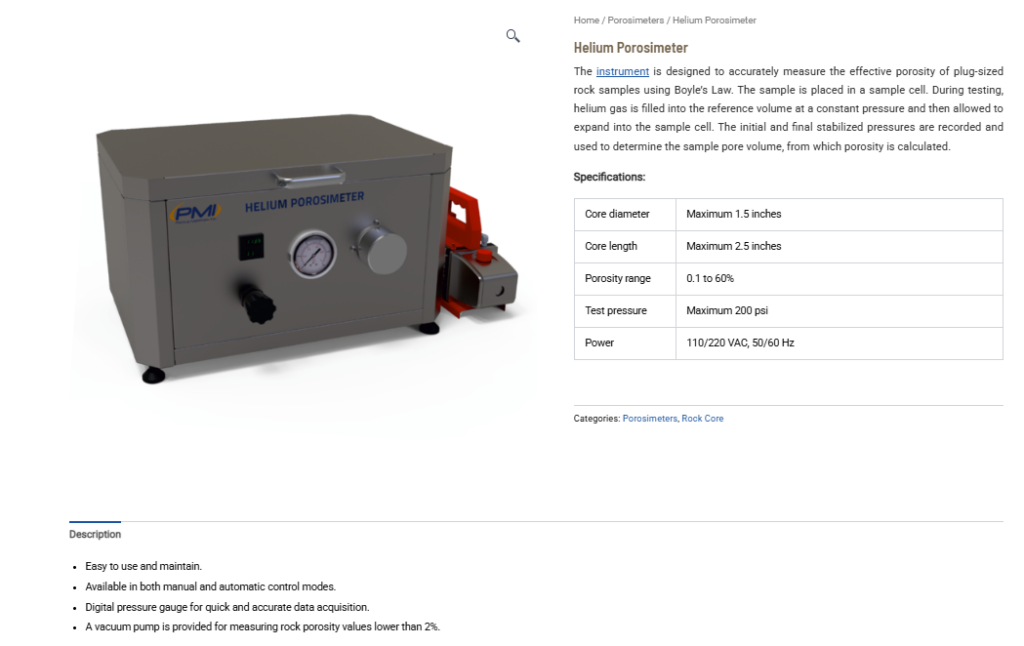
Organizations that want to help their main tests be better and more right can find a Helium Porosimeter to be useful in lab work.
BY: PMIAPP