
Introduction
Learning about porous materials can help people make better products in many fields. Some of these fields are energy storage, catalysis, medicine, filtration, nanotechnology, environmental engineering, and research for new materials. It is good to know the surface area, pore size, how much can fit inside, and how these materials can hold other things. This can help people do their research well. They can also make these materials work better. It helps things to work well and lets people come up with new ideas faster.
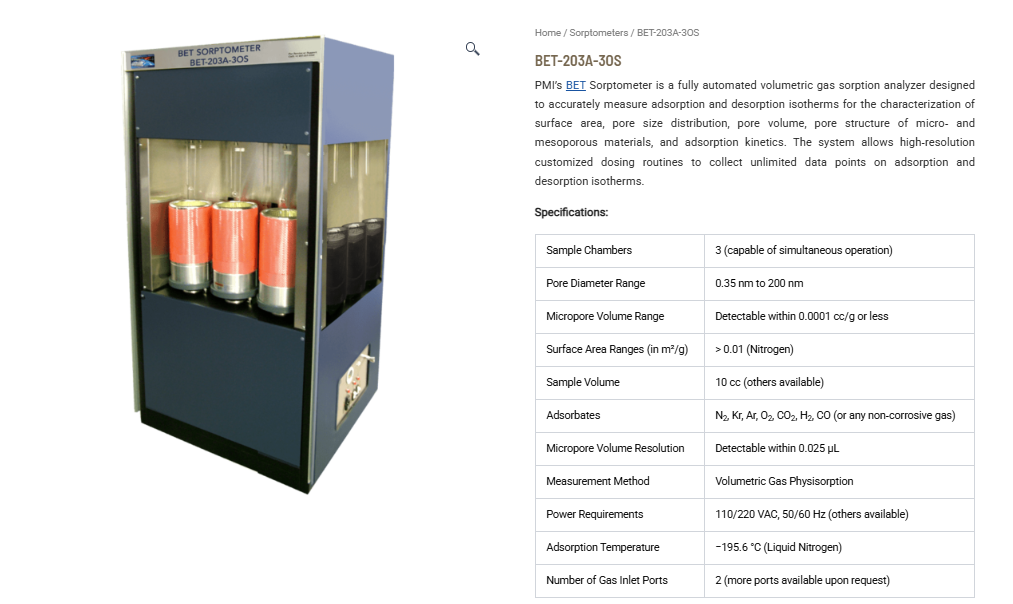
The BET-203A-30S Gas Sorption Analyzer from PMI is a tool that does all the work for you. It checks how gas goes into and comes out of micro- and mesoporous things. This system gives you good results each time you use it. The BET-203A-30S can test more than one sample at once. You can also handle gas in better ways and set up your own dosing steps. You get results that are strong and clear. The BET-203A-30S helps labs and business users know more about what their materials do.
What is Gas Sorption Analysis?
Gas sorption analysis is a trusted method used to find out about the physical properties of things that have tiny holes. It works by measuring how much gas goes onto the surface and how much gas comes off the surface of the thing.
This way helps people get good information about:
- Specific surface area
- Pore size spread
- Pore space
- Small pore details
- Adsorption speed
- How porous the substance is
These measurements help us see how materials work with gases, liquids, and chemical compounds in the real world. This helps people know more about what the material can do.
Why Surface Area and Porosity Matter
How the inside of porous materials is made changes how they work. This has a big effect on what they do in many uses.
Here are some important things that the pore structure can affect:
- How well the catalyst can work
- How much the catalyst can hold
- How well the catalyst can filter
- How much gas the catalyst can store
- How well the catalyst can work with power
- How the catalyst handles the water
- How well the catalyst can separate things
- How active the catalyst is with chemicals
When people measure these things well, they can make better choices when they design something. This way, they help products work better.
Overview of the BET-203A-30S
The BET-203A-30S is a smart tool that checks gas sorption. It can see how gas sticks to surfaces and how it leaves. This tool gives very clear details and lets you do many things with it.
The system supports:
- BET surface area check
- Pore size check
- Micropore volume check
- Adsorption speed studies
- Multi-gas adsorption check
- High-detail isotherm study
The system lets you set up dosing the way you like. It is good for regular tests and research, too. There is automation in the system to help you do your work. It makes the process simple for you.
Key Features of the BET-203A-30S
Three Simultaneous Sample Chambers
The instrument is equipped with:
3 Independent Analysis Ports
This helps people look at many samples at one time. It makes work in the lab go faster and be better for everyone.
Benefits include:
- You can check more samples.
- The testing will take less time.
- You can see different materials and find out how they compare.
- Research will be quicker and better.
High-Resolution Adsorption Analysis
The BET-203A-30S lets you set up your own dosing plans. This helps you get more data for both adsorption and desorption.
Advantages include:
- Better isotherm resolution
- A better way to look at pores
- A more clear look at adsorption kinetics analysis
- More choices for doing experiments
This feature is good if you want to look at deep holes in things or check out new materials. It helps people when they need to study these areas.
Wide Pore Size Measurement Range
The system lets you see pore structure well. It shows details for the pores in many sizes.
Pore Diameter Range
0.35 nm to 200 nm
This enables analysis of:
- Microporous materials
- Mesoporous materials
- Nanoporous structures
- Advanced composite materials
Researchers can see more about how these pores form and how things move through them.
Exceptional Micropore Analysis Capability
Micropores are key for many things. They help to take in other things. They can hold gas. They help with changes in chemicals. They also help to sort things apart.
Micropore Volume Detection
Detectable within 0.0001 cc/g or less
Micropore Volume Resolution
Detectable within 0.025 µL
These features help people see a clear view of very small pore shapes and little spots where things can stick.
BET Surface Area Measurement
The BET-203A-30S gives good results when you want to find the specific surface area. It uses the adsorption methods that many people in the industry know and use.
Surface Area Range
Greater than 0.01 m²/g (Nitrogen Method)
Suitable for:
- Activated carbons
- Catalysts
- Zeolites
- Nanomaterials
- Materials used in power storage
- Membranes
- Adsorbents
Having the right surface area information can help you get the most out of how a thing works. This is important in many uses.
Multi-Gas Adsorption Flexibility
One good thing about the BET-203A-30S is that you can use it with many types of gas.
Supported Adsorbates
- Nitrogen (N₂)
- Krypton (Kr)
- Argon (Ar)
- Oxygen (O₂)
- Carbon Dioxide (CO₂)
- Hydrogen (H₂)
- Carbon Monoxide (CO)
- Other Non-harmful Gases
This setup lets people do special adsorption tests. You can use it to study different materials. It also helps you look at many research goals.
Advanced Volumetric Gas Physisorption Technology
The BET-203A-30S uses volumetric gas physisorption. This is one of the most trusted ways to check porous stuff.
This technique enables:
- Surface area check
- Adsorption isotherm setup
- Desorption study
- Pore volume check
- Pore size spread check
- Adsorption speed measure
Researchers get support when they see results that stay the same and can be tested again. These results are good for deep studies and to help grow new things in the industry.
Low-Temperature Adsorption Analysis
The instrument works in cold places. That is where adsorption takes place. This helps the tool to give good measurements.
Adsorption Temperature
-195.6°C (Liquid Nitrogen)
This temperature is used a lot for BET analysis. People also use it to look at the structure of pores.
Flexible Gas Handling System
The BET-203A-30S includes:
Multiple Gas Inlet Ports
2 Standard Gas Inlet Ports
You can ask for more ports if you need them for special uses. This can help if you do advanced gas adsorption studies.
This flexibility helps with many types of research. It also is good for a lot of testing needs.
Technical Specifications
| Specification | Details |
|---|---|
| Sample Chambers | 3 (Simultaneous Operation) |
| Pore Diameter Range | 0.35 nm to 200 nm |
| Micropore Volume Detection | 0.0001 cc/g or Less |
| Surface Area Range | > 0.01 m²/g |
| Sample Volume | 10 cc (Others Available) |
| Adsorbates | N₂, Kr, Ar, O₂, CO₂, H₂, CO, and Other Non-Corrosive Gases |
| Micropore Volume Resolution | 0.025 µL |
| Measurement Method | Volumetric Gas Physisorption |
| Adsorption Temperature | -195.6°C |
| Gas Inlet Ports | 2 Standard (Additional Available) |
| Power Requirements | 110/220 VAC, 50/60 Hz |
Applications of the BET-203A-30S
Catalyst Development
Researchers use the system to optimize:
- Catalyst helps.
- Surface activity.
- How well it works.
- Design of pore structure.
Energy Storage Materials
Ideal for characterizing:
- Battery ends
- Supercapacitor stuff
- Hydrogen storage parts
- Fuel cell parts
Nanotechnology Research
The instrument supports analysis of:
- Nanoparticles
- Nanotubes
- Nanocomposites
- Functional nanomaterials
Environmental Applications
Used to evaluate:
- Activated carbon
- Adsorbents
- Air purification media
- Water treatment materials
Pharmaceutical Research
Supports characterization of:
- Drug delivery systems
- Pharmaceutical powders
- Porous excipients
- Controlled-release materials
Membranes and Filtration
Researchers analyze:
- Separation membranes
- Filtration media
- Porous barriers
- Advanced filtration materials
Benefits of the BET-203A-30S
High-Resolution Data Collection
Custom dosing routines let you look at how things stick to a surface and come off it. You get to study this in detail.
Multi-Sample Productivity
There are three sample chambers that you can use at the same time. This will help the lab to get more work done.
Broad Gas Compatibility
This helps with many types of adsorption studies. You can also use it in different kinds of research work.
Exceptional Sensitivity
The advanced tools help us find small holes. We use them to look at things that have many spaces inside them.
Reliable Automated Operation
It cuts down on the need for people to help out. It also helps make sure things are done the same way each time to improve how they work.
Why Choose PMI’s BET-203A-30S?
PMI is known by many people around the world. The company makes tools to check things that let air through and to see how well they hold other stuff.
The BET-203A-30S offers:
- Works on its own with no help.
- Gives high-resolution data when it measures how things stick to a surface.
- Checks what makes up the pores.
- Works with different kinds of gases.
- Can test more than one sample at the same time.
- Picks up small changes very well.
- Made for research uses.
These things help make it a good option for schools, research teams, big labs, and people who work with new stuff.
Conclusion
The BET-203A-30S Gas Sorption Analyzer gives quick and reliable checks of surface area, pore size spread, micropore space, and how gases stick to porous things. It uses smart controls that change how it adds gas. It works with many kinds of gas and lets you test several samples at the same time. These features help people who study things get the data they need. It also gives them the options they want for deep testing.
No matter if you work in catalysis, nanotechnology, energy storage, environmental science, pharmaceuticals, or filtration research, the BET-203A-30S will give you the right results. It also lets you see small changes and helps you save time. This lets new ideas for development move ahead.
BY: PMIAPP