
Introduction
How porous materials work is shaped by several things. These include how much surface area they give, how big the pores are, how many pores there are, and how well the material can adsorb. All these things change how the material will react with gases, liquids, or other chemicals. So, knowing this is key in jobs like catalysis, making medicines, saving energy, filtration, environmental engineering, and nanotechnology.
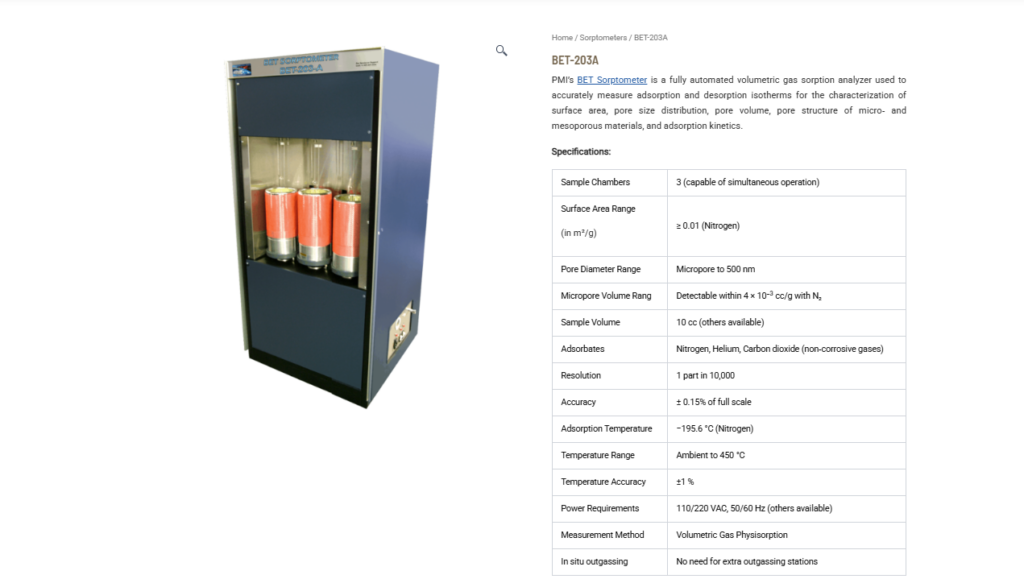
The BET-203A Gas Sorption Analyzer from PMI is a tool that checks gas adsorption and desorption by itself. It shows you clear results, so you can find out more about your samples. This system can test three samples at the same time. It comes with useful things for looking at pores and works easily, so you do not need to do much. The BET-203A gives you good and steady data. It is a good choice for people who work in labs, those at universities, and for testing quality at many places.
Understanding BET Surface Area Analysis
BET (Brunauer-Emmett-Teller) surface area analysis is a good way to see the exact surface area in both porous and non-porous things. A lot of people use it, and many labs use this method too.
The method uses gas, which sticks to a surface. A set amount of gas will stay on that surface when the time and conditions are right. This is known as an adsorption isotherm. It helps to see the full area that the gas can cover.
BET analysis is commonly used for evaluating:
- Catalysts
- Activated carbon
- Zeolites
- Nanomaterials
- Ceramics
- Membranes
- Adsorbents
- Pharmaceutical powders
- Materials used for power storage
Having good surface area numbers helps people get better results. They can use these numbers to make things work better. The numbers also help us learn about the shape and how things connect.
What is the BET-203A Gas Sorption Analyzer?
The BET-203A is a new tool that checks gas levels. It shows you how much gas sticks to and leaves a surface. You can use it to see more about the small holes in the surface.
The tool gives clear info about:
- Surface area
- Pore size range
- Pore volume
- Micropore traits
- Adsorption speed
- Openness
The BET-203A works with volumetric gas physisorption methods. With this, you can see both micro and mesoporous materials in a clear way. The level of detail you get is very high.
Key Features of the BET-203A
Fully Automated Operation
The BET-203A does all the work for you in both adsorption and desorption. You do not need to do much when you test. It makes sure that every test stays the same each time.
Benefits include:
- There are less people mistakes.
- The results are the same every time.
- It is a faster way to check.
- More work can be done in the laboratory.
Three Simultaneous Sample Chambers
The BET-203A is good because you can check a lot of samples at once.
Sample Chambers
3 Independent Analysis Ports
This capability allows:
- You can take on more work.
- You finish jobs faster now.
- You can see many kinds of things.
- The lab works better now.
If research centers work with a lot of samples every day, checking more than one sample at once can save time on testing. This can help them finish their work faster.
Wide Surface Area Measurement Range
The instrument can look at items that have small or big surface areas.
Surface Area Range
≥ 0.01 m²/g (Nitrogen Method)
This range supports characterization of:
- Low surface area solids
- Porous ceramics
- Activated carbons
- Nanostructured materials
- Catalyst supports
Comprehensive Pore Structure Analysis
The BET-203A gives you clear details on pore size. You can use this tool to look at many kinds of pore sizes.
Pore Diameter Range
Micropores to 500 nm
This allows analysis of:
- Microporous materials
- Mesoporous materials
- Macroporous structures
- Mixed porous systems
It is important to know where the pores are in a thing. This helps people get the most out of adsorption. It also helps with filtration. And it is good for catalytic tasks.
High-Sensitivity Micropore Detection
Microporous materials are used for gas storage. You can use them to split gases. They help make chemicals, too. A lot of people use microporous materials for the environment.
Micropore Volume Detection
Detectable within 4 × 10⁻³ cc/g using Nitrogen
This feel lets you see the small shapes in pores and places where there is not much adsorption.
Advanced Gas Adsorption Capabilities
The BET-203A can use a few types of gases. These gases are safe when you need to check how something sticks to a surface.
Available Adsorbates
- Nitrogen (N₂)
- Helium (He)
- Carbon Dioxide (CO₂)
Different gases let you see lots of things and the way that some holes look.
Volumetric Gas Physisorption Technology
The instrument uses volumetric gas physisorption ways to work. It lets you see how gas sticks to a surface. It also shows how gas gets off the surface.
This method enables:
- BET surface area calculations
- Adsorption isotherm generation
- Pore volume measurements
- Pore size distribution analysis
- Adsorption kinetics evaluation
Volumetric analysis is a way that people in the world use to find out how much space or holes are in something. It helps us see how porous an object is.
High Resolution and Accuracy
The BET-203A is made to give you good results every time you use it.
System Resolution
1 Part in 10,000
Accuracy
±0.15% of Full Scale
These needs help us do research and check for quality the right way. They make sure we get good results and keep things steady.
Broad Temperature Capabilities
It is important to keep the right temperature when you do adsorption analysis. This helps to get good and clear results. If the temperature is not correct, the numbers may be wrong. So, always watch the temperature during the process.
Adsorption Temperature
-195.6°C (Nitrogen Analysis)
Temperature Range
Ambient to 450°C
Temperature Accuracy
±1%
You get a lot of freedom with this. You can have samples ready to use and try them in many things. It will work for different types of jobs, too.
Integrated In-Situ Outgassing
How you get a sample ready is important for good results in adsorption data.
The BET-203A includes:
In-Situ Outgassing Capability
Advantages include:
- You do not have to use other places for outgassing.
- You touch the samples less.
- The whole workflow will be smoother.
- The measurements can be more trusted.
Using built-in outgassing can make lab work easier. It helps your lab work well. It also keeps the high level of testing standards.
Technical Specifications
| Specification | Details |
|---|---|
| Sample Chambers | 3 (Simultaneous Operation) |
| Surface Area Range | ≥ 0.01 m²/g |
| Pore Diameter Range | Micropore to 500 nm |
| Micropore Volume Detection | 4 × 10⁻³ cc/g |
| Sample Volume | 10 cc (Other Sizes Available) |
| Adsorbates | Nitrogen, Helium, Carbon Dioxide |
| Resolution | 1 Part in 10,000 |
| Accuracy | ±0.15% Full Scale |
| Adsorption Temperature | -195.6°C |
| Temperature Range | Ambient to 450°C |
| Temperature Accuracy | ±1% |
| Measurement Method | Volumetric Gas Physisorption |
| In-Situ Outgassing | Included |
| Power Requirements | 110/220 VAC, 50/60 Hz |
Applications of the BET-203A
Catalyst Development
How a catalyst works is often tied to the size of its surface and the way its pores are built. A bigger surface gives the catalyst more space to do its work. The shape of the pores is also a big part of how well it can get this done.
Applications include:
- Catalyst optimization
- Support characterization
- Activity enhancement studies
Nanotechnology Research
Researchers use BET analysis for:
- Nanoparticles
- Nanotubes
- Nanocomposites
- Functional nanomaterials
Energy Storage Materials
The instrument supports analysis of:
- Battery ends
- Supercapacitor items
- Hydrogen keeping stuff
- Fuel cell parts
Pharmaceutical Development
BET measurements help characterize:
- Active pharmaceutical ingredients
- Drug delivery materials
- Powder formulations
- Controlled-release systems
Environmental Applications
Used for evaluating:
- Activated carbon
- Adsorbents
- Water treatment materials
- Air purification media
Membranes and Filtration Media
Researchers analyze:
- Porous membranes
- Filter materials
- Separation media
- Advanced filtration systems
Benefits of Using the BET-203A
Increased Laboratory Productivity
There are three sample chambers that can work at the same time. This helps the tests go faster. You can get more done with this.
Comprehensive Material Analysis
It checks the surface area. It also checks the hole size. The system looks at the total space in the holes. It checks how things stick to the surface, all in one system.
Reliable and Repeatable Results
Smart tools help testing be smooth and steady.
Flexible Material Compatibility
This works well on many surfaces. You can use it on things that take in water. It is also good for things that do not.
Reduced Operating Costs
Integrated outgassing does the work, so you do not need to use other tools to get your sample set.
Why Choose PMI’s BET-203A?
PMI is a name that many people know in many places around the world. The company tests how much things can pass through something. PMI also makes tools that help people look at things in a very close way.
The BET-203A provides:
- The system works by itself and does not need people to help.
- It can check up to three samples at the same time.
- It gives very clear results.
- It shows all the details about the size and shape of the pores.
- It uses top ways to study adsorption.
- You can trust it for hard research work.
- It helps companies keep up with their product checks.
These features make it a good pick for groups who want fast and steady surface area and porosity checks. It can handle a lot of tests at one time. You can feel good about the results it gives.
Conclusion
The BET-203A Gas Sorption Analyzer is a strong and simple tool. You can use it to check the surface area and learn about pore size. It can also do adsorption tests. This machine works by itself. You can test three samples at one time. The built-in outgassing makes things easy. There is advanced gas physisorption, too. This helps people in research see how things act. It also helps them make their products better.
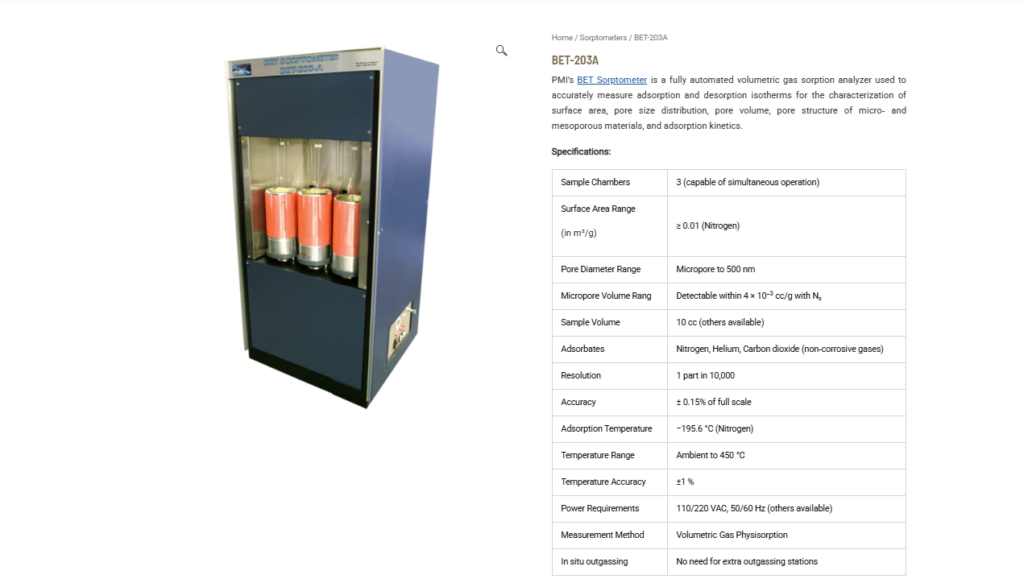
No matter if you work in catalysis, nanotechnology, pharmaceuticals, energy storage, filtration, or environmental research, the BET-203A gives you the results you want. You can use it to work faster and feel sure that your test results are correct. The BET-203A helps you see new materials in the best way.
By: PMIAPP